Wednesday, 9 November 2011

Q for Quills

image

As far as the use of Quills is concerned, I think I could have been accepted as a Hogwarts student. … Back in my childhood or teens (long before Harry Potter first popped up in J.K. Rowling’s mind), I used to practice writing with quills made out of crow-feathers. (Just for fun. I’m not quite so old that I did not have access to pens and pencils.)

In The Order of the Phoenix there is a nasty Quill in use which does not need dipping in ink because it uses your own blood instead. Harry is forced by Professor Umbridge to use it to write the text “I must not tell lies” and the words appear on his hand instead of on the paper.

 image

Another famous quill from the Harry Potter books and films is the Quick Quotes Quill used by reporter Rita Skeeter in The Goblet of Fire. This is a magical quill that automatically twists whatever you say into sensational newspaper stuff. I’m not so sure those aren’t secretly used by Muggle reporters as well!

image

ABC Wednesday

Wednesday, 25 May 2011

S for Severus Snape (ABC Wednesday)

image

Alan Rickman as Severus Snape in the Harry Potter films

image

The name Snape is an old one with roots probably dating back to before the Norman Conquest in 1066 AD. There is also more than one place in England called Snape.

Severus is Latin meaning stern, strict, serious.

Severus Snape is Harry’s most hated teacher at Hogwarts. Already in the first book he and Harry take an instant dislike to each other. With Harry it is an instinct kind of thing; with Severus it is based on old grudges to do with Harry’s parents. He despised Harry’s father, and in later books, we learn more about why.

(spoiler warning)

As discussed in a previous post, I believe Rowling has been very conscious of coats of arms and family crests connected with the surnames of her main characters. The stag is a common symbol in heraldry, and it occurs both in the Evans coat of arms (the maiden name of Harry’s mother) and in the Snape coat of arms.

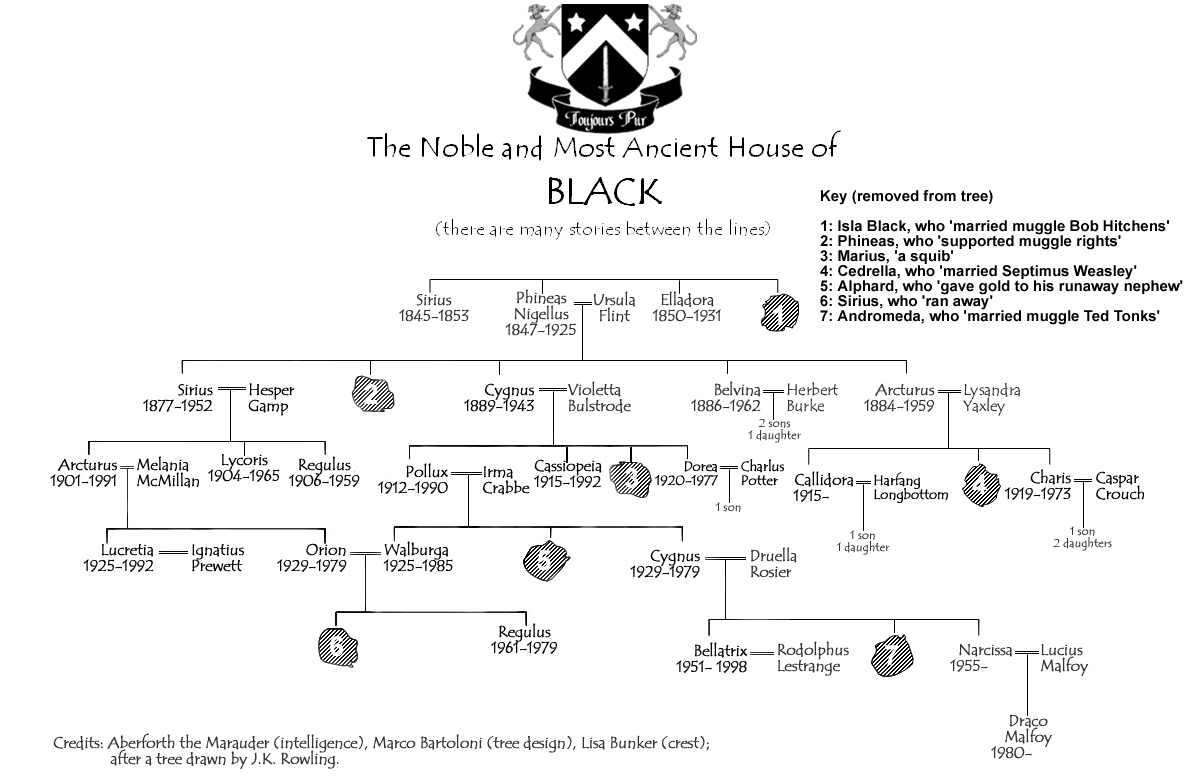
N.b. no direct references to these particular coats of arms and family crests are given in the books; this is all “under the surface” stuff. Importance (or not!) of heritage and ancestry are part of the story though. For example the Black family tree is presented in the fifth book, and the Peverell coat of arms is introduced as a mystery factor in the sixth one.

Harry’s “patronus” shape is a stag. (A patronus is a kind of personal magic guardian that among other things can protect from Dementor attacks. It is closely connected to happy memories and what/whom you love.) The stag was also his father’s Animagus shape (James could transform himself into a stag). In the last book we learn that Snape’s patronus is a doe, and so was that of Lily Evans.

Even from the fifth book it was possible to deduct that there might have been some kind of friendship between Severus and Lily in the past, before she started going out with James. Not until the end of the last book do we get the full picture though: Severus and Lily having a bond that goes back even before Hogwarts.

With Severus Snape, Rowling managed to create an intriguing and mysterious character who got much debated among the readers who followed the series as it was being written. While Harry was clearly the main hero, and Voldemort clearly the main representative of evil; one strength of this series of books is that it also has a number of characters less easy to classify; Snape being the most tricky of them all. And or course there is only one letter that dissociates Snape from Snake…

Not only is Snape Head of the Slytherin’ House at Hogwarts – “There’s not a single witch or wizard who went bad who wasn’t in Slytherin” (PS5; said by Hagrid). It also turns out in later books that he even used to be a Deatheater, i.e. one of Voldemort’s followers. And yet Dumbledore seems to trust him. But he never reveals his reasons…

As the seventh book opens, with Dumbledore gone from the scene, it may seem there is not much room for doubt any more, where Snape’s true loyalty lay. However, this is a book that has doubt as one of it main themes, and things keep getting twisted and turned a few times more before the story finally comes to an end.


Wednesday, 11 May 2011

Q for Quidditch (ABC Wednesday)

image

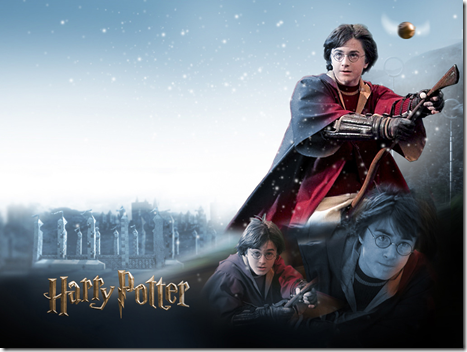
The favourite sports game in J.K. Rowling’s Wizarding world is Quidditch. When Harry is first introduced to it (in the first book, Harry Potter and the Philosopher’s Stone) he tries to sum up his first impression: ‘So – that’s sort of like basketball on broomsticks with six hoops, isn’t it?’

Well, not quite. There are four balls involved – one Quaffle, two Bludgers and the Snitch. And the seven players on each team are divided into one Keeper, three Chasers, two Beaters and one Seeker.

‘Three Chasers try and score with the Quaffle; the Keeper guards the goalposts; the Beaters keep the Bludgers away from their team,’ ...

image

Harry’s position, however, is to be that of Seeker.

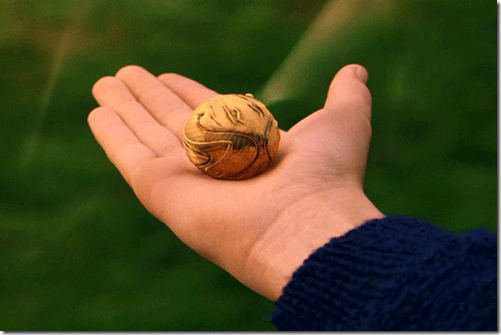
‘This,’ said Wood, ‘is the Golden Snitch, and it’s the most important ball of the lot. It’s very hard to catch because it’s so fast and difficult to see. It’s the Seeker’s job to catch it. You’ve got to weave in and out of the Chasers, Beaters, Bludger’s and Quaffle, to get it before the other team’s Seeker, because whichever Seeker catches the Snitch wins his team an extra hundred and fifty points, so they nearly always win. That’s why Seekers get fouled so much. A game of Quiddich only ends when the Snitch is caught, so it can go on for ages – I think the record is three months, they had to keep bringing on substitutes so the players could get some sleep. Well that’s it – any questions?’

image

Quidditch plays a big role throughout the books, except for the last book, which mostly takes place away from school. But the last book still involves a lot of the same elements as a Quidditch game – only more serious. Harry’s role as Seeker is also symbolic throughout the series.

In the first book, a book called Quidditch Through the Ages is referred to. Rowling later published a small book by that name in a separate volume, donating the proceeds to a charity organization called Comic Relief.


Tuesday, 3 May 2011

P for Pensieve (ABC Wednesday)

image

Memories play an important part in the Harry Potter story. In last week’s post, I mentioned occlumency – “the magical defence of the mind against external penetration” – and legilimency – “the ability  to extract feelings and memories from another person’s mind”. As I said then: In Rowling’s Wizarding World, this can get a little more ‘physical’ than we are used to in the Muggle world…

In his Headmaster’s office at Hogwarts, Professor Dumbledore keeps a magical device called the Pensieve. It is introduced to us in Chapter 30 of the fourth book, The Goblet of Fire. Harry discovers it while he is waiting for Dumbledore in his office:

A shallow stone basin lay there, with odd carvings around the edge; runes and symbols that Harry did not recognize. The silvery light was coming from the basin’s contents, which were like nothing Harry had ever seen before. He could not tell whether the substance was liquid or gas. It was a bright, whitish silver, and it was moving ceaselessly; the surface of it became ruffled like water beneath wind, and then, like clouds, separated and swirled smoothly. It looked like light made liquid – or like wind made solid – Harry couldn’t make up his mind.

When Harry bends down over it, he find himself drawn into the substance, and transported to another place and time, where all he can do is watch (he cannot interfere).

When he gets pulled back into the present time, he asks Dumbledore what the thing is.

‘This? It is called a Pensieve,’ said Dumbledore. ‘I sometimes find, and I am sure you know the feeling, that I simply have too many thoughts and memories crammed into my mind.’
’Er,’ said Harry, who couldn’t truthfully say that he had ever felt anything of the sort.
’At these times,’ said Dumbledore, indicating the stone basin, I use the Pensieve. One simply siphons the excess thoughts from one’s mind, pours them into the basin, and examines them at one’s leisure. It becomes easier to spot patterns and links, you understand, when they are in this form.’
’You mean … that stuff’s your thoughts?’ Harry said, staring at the swirling white substance in the basin.
’Certainly,’ said Dumbledore. ‘Let me show you.’

image

Whereupon he demonstrates by drawing out his wand, placing the tip of it near his temple, drawing out a glistening strand of the same kind of substance from his head, adding it to the Pensieve and swirling the stone basin “rather as a gold prospector would swirl for fragments of gold”.

The word Pensieve is of course derived from “pensive” (=deeply thoughtful) and “sieve” (utensil for straining or sifting etc).

The Pensieve continues to be an important object throughout the rest of the series; as is the whole idea of being able to dive into another person’s memories.

The most important difference between using the Pensieve and just listening to someone telling you about their memories, is that with the Pensieve, you get an objective view of what happened; and you are free to draw your own conclusions about it.

But to be able to use the Pensieve, you must first obtain the memory you want to examine, in the form of that physical substance.

Tuesday, 26 April 2011

O for Occlumency (ABC Wednesday)

image

Occlumency: “The magical defence of the mind against external penetration. An obscure branch of magic, but a highly useful one.”

Severus Snape to Harry Potter in The Order of the Phoenix, Ch 24

While Harry is spending the Christmas holidays at the house of his godfather Sirius, his most hated teacher, Snape, turns up and delivers the very unwelcome message that during the next term, the Headmaster, Professor Dumbledore, wants Harry to take private Occlumency lessons from no other than Professor Snape.

‘Dumbledore wants to stop you having those dreams about Voldemort,’ said Hermione at once. ‘Well, you won’t be sorry not to have them any more, will you?’

‘Extra lessons with Snape?’ said Ron, sounding aghast. ‘I’d rather have the nightmares!’

When the lessons start, Snape explains things a bit further. The reason why Dumbledore wants Harry to learn Occlumency is that the Dark Lord (Voldemort) is “highly skilled at Legilimency”, which is “the ability  to extract feelings and memories from another person’s mind”. (A Muggle would call it mind-reading, but in the wizarding world it gets a little more physical.) Occlumency, on the other hand, “seals the mind against magical intrusion and influence”.

Since Harry has a rather emotional personality, he never gets very good at occlumency; but, to quote Dumbledore further on in the story: “in the end, it mattered not”, because he has other qualities that serve him better.

Snape, however, is sort of the embodiment of Occlumency; his character remains a mystery throughout the series, and where his true loyalty lay was one of the favourite subjects of debate while readers were waiting for the last book in the series.

Tuesday, 19 April 2011

N for Nagini (ABC Wednesday)

Nagini is the name of a big snake closely associated with Lord Voldemort, Harry Potter’s main enemy.

Naga is the sanskrit word of a deity taking the shape of a snake. It is sometimes also used for ordinary snakes, like the cobra. A female naga is a nagi or a nagini. (Wikipedia)

Nagas are sometimes characterized as having human traits at one time, and serpent-like traits at another.

The Cobra was also used as a symbol of sovereignty, royalty, deity, and divine authority in ancient Egypt. The Ureaus, the rearing cobra, on the pharaoh’s crown is a symbol of an Egyptian goddess (Wadjet) who was often depticted as a cobra.

Very early in the first book in the HP series, we learn that Harry is able to communicate with snakes (he talks to one at the zoo, while he is still living with his aunt and uncle in the Muggle world and does not even know himself yet that he is a wizard).

It is not until his second year at Hogwarts that Harry himself learns that this ability is regarded with suspicion even among wizards; and that when he does it, he is in fact using a special language called parseltongue. A language which Harry never consciously learned, which most wizards neither speak nor understand, and which is associated with the Dark Arts.

There is a big snake involved in The Chamber of Secrets: a basilisk. But the basilisk is not Nagini.

Nagini is not introduced until the fourth book: The Goblet of Fire. But from then on and until very close to the end, Nagini is closely related to Lord Voldemort.

Already in the first book, we learn that Lord Volemort tried, but failed, to kill Harry when he was a little baby, just over a year old. For unknown reason, the curse he cast on Harry seemed to rebound on himself, and he was so much weakened by this that he lost his bodily shape. When we first meet Voldemort (in the first book), he is literally only a shadow of his former self. In the fourth book, after his ‘resurrection’, he gives his old followers, the Death Eaters, a summary: 

I was ripped from my body, I was less than spirit, less than the meanest ghost… but still, I was alive. --- Only one power remained to me. I could possess the bodies of others. (GoF 33)

In The Goblet of Fire, however, Lord Voldemort regains a body of his own. We learn that a potion containing snake venom from Nagini was one essential ingredient in the mix of magic that got him started in that process. It is also a fact that when he does come back in bodily shape, it is with a very snakelike appearance.

Even though all the details are not clearly stated, a sort of first bodily rebirth trough the snake Nagini is suggested – to give him back a “rudimentary, weak body of my own, a body I would be able to inhabit while awaiting the essential ingredients for true rebirth” (GoF33).

Beneath the surface of this story, there are many layers of deep imagery; and Rowling borrows from more than one source. One thing that to me stands out beyond doubt though, is that Tom Riddle/Lord Voldemort is meant to be an ‘Antichrist’ figure. Besides the basic concept of ‘the Beast’ in the Book of Revelations, Rowling also uses ‘anti’-analogies like: While Jesus according to Christian belief was both human and divine; the ‘reborn’ Lord Voldemort is half human, half snake. And while Jesus sacrificed himself for others, Tom/Voldemort without hesitation sacrifices others for himself. 

In Revelations Ch 13, a scene is described where a beast with seven heads comes out of the sea. All its heads are different. A dragon (dragons and snakes are more or less interchangable in many old stories) “gave the beast his power and his throne and great authority. One of the heads of the beast seemed to have had a fatal wound, but the fatal wound had been healed. The whole world was astonished and followed the beast.” (Rev 13:3)

As the HP story goes on, it becomes clear that Lord Voldemort too has “more than one head”, and therefore is no ordinary enemy. 

There also seems to be a mysterious bond between Harry and the Dark Lord, to do with the scar that Harry still has on his forehead from when Voldemort tried to kill him back in his childhood. What protects Harry though is the fact that his mother (Lily) sacrificed her own life for him. There is magic in sacrificial love which goes beyond Voldemort’s understanding; and of course, in the end that proves to be his downfall.

In connection with Nagini there are also references implied to the Ouroborus symbol depicting a serpent or dragon eating its own tail. (For example, in GoF33, Nagini is described as “continually circling” while Voldemort tells his story to the Death Eaters.) In religious, mythological and alchemical symbolism it represents recreation and other things perceived as cycles. Alchemy is another of the recurring themes in the HP books.

image

Tuesday, 12 April 2011

M for Marauder’s Map (ABC Wednesday)

image

image

Click here to watch the YouTube video clip from The Prisoner of Azkaban where the Marauder’s Map of Hogwarts Castle is first introduced.

The map is presented to Harry by the Weasley twins Fred and George, who in their first year nicked it from the office of the very impopular school caretaker, Argus Filch. He in turn had confiscated it years before, from the makers of the map, the four Marauders who called themselves Moony, Wormtail, Padfoot and Prongs – all of whom we get to know more about before the end of the third book.

It was a map showing every detail of the Hogwarts castle and grounds. But the truly remarkable thing was the tiny ink dots moving around it, each labelled with a name in minuscule writing. (PoA 10)

The spell to open the map is: “I solemnly swear that I’m up to no good.” And to close it: “Mischief managed.”  Which makes it go back to just a blank piece of parchment for the eyes of those who don’t know its secret.

The map is also put to use in the rest of the series. One of its really tricky qualities is that the little moving dots always show the true name of the person. Something which can be both helpful and deceitful in a world where wizards and witches sometimes use magic to take on someone else’s appearance…

The map is one of the magical objects that come to Harry as a sort of heritage from his father, although he is not aware of it at the time.

… … …

This post is linked to ABC Wednesday.

Tuesday, 5 April 2011

L for Luna (ABC Wednesday)

Luna Lovegood is a character not introduced until the fifth book in the series, although presumably she has been attending Hogwarts since Harry’s second year – being in the same year as Ginny Weasley; but belonging to the House of Ravenclaw rather than to Gryffindor.

Harry (in the company of Neville and Ginny) is first introduced to Luna (sometimes nicknamed ‘Loony’ by her fellow students) on the train to Hogwarts:

The girl gave off an aura of distinct dottiness. Perhaps it was the fact that she had stuck her wand behind her left ear for safekeeping, or that she had chosen to wear a necklace of Butterbeer corks, or that she was reading a magazine upside-down. (OP10)

(It turns out after a while, though, that there was a reason why she was holding the magazine upside-down.) The magazine is The Quibbler, a publication not reputed in the Wizarding World to be the most reliable source of information. However, the editor is Luna’s father; and although he does not know it when they first meet, this will prove useful for Harry later on. Daring to be different – a quality shared by both father and daughter Lovegood – is not necessarily a bad thing. 

The name Luna is Latin for Moon. This fits perfectly with Luna Lovegood’s late appearance in the story. When she comes into it, “darkness” has already begun to take over, after Lord Voldemort again took bodily form at the end of the fourth book. Luna’s first appearance might seem a bit bleak, but before the end, she does get to shine.

Luna in Roman mythology is a moon goddess. (In Greek mythology her name is Selene.) She is often depicted riding either riding on a horse or in a chariot drawn by a pair of winged steeds. Her lunar sphere or crescent is often represented as a crown set upon her head. 

Luna also appears in a sort of trinity with two other moon goddesses: Diana, connected with the woods, wild animals and hunting, and Hecate, connected with the underworld, and with doorways and crossroads. It is said that Luna represents the full moon, Diana the crescent moon, and Hecate the darkness when we don’t see the moon at all.

Interestingly, I also found a note in one of my mythology books that Hecate is sometimes depicted with three different heads: the lion, the horse and the dog.

In The Order of the Phoenix, where we meet Luna, we are also introduced to Thestrals, a kind of invisible, winged, skeleton-resembling, horse-like creatures (used to pull the carriages that transport the students between Hogwarts and the train station). Thestrals can only be seen by those who have seen death. Harry never sees the thestrals until his fifth year – before that the carriages used to seem to him to be moving by magic. Now he can see them, because at the end of his previous school year, he saw a fellow student (Cedric) get killed by Voldemort. Ron and Hermione cannot see the thestrals, so at first don’t understand what Harry is talking about. Luna, however, sees them (her mother died when she was nine), and assures Harry that “You’re just as sane as I am.”

image

The lion is the symbol of the House of Gryffindor (representing fire/light). In OP19, Luna turns up to a Quidditch game showing support for Gryffindor (against Slytherin) wearing a hat shaped like a lion’s head.

image

As for the dog, that’s the animagus shape that Sirius (Harry’s godfather) takes – a big black dog, also associated (in one of the earlier books) with the omen of death, the Grim. In OP, Luna is one of the friends who accompany Harry on a mission to (presumably) rescue Sirius from the “underworld”: Towards the end of the book, she, Harry, Ron, Hermione, Ginny and Neville all fly on thestrals to London, where they enter the Department of Mysteries in the Ministry of Magic headquarters, located underground. One of the most important scenes takes place in a sort of underground amphitheatre; which further connects to old Greek/Roman mythology and drama. There is also an arch (doorway) with a mysterious veil; and Harry and Luna are the only ones who can hear voices “from the other side” (although at the same time you can walk around the arch and see both sides of it).

One person in this scene falls through the veil – and is thereby taken “off stage”, so to say. See a previous post of mine: Dog Days and Sirius Black.

Luna Lovegood’s interest in mystical magical creatures might be another clue to associate her with Diana, the moon godess also associated with woods and wildlife. It is however sort of left open by the author whether some of the creatures whose existence Luna takes for granted are supposed to really exist. - My favourite, of course, is the Crumple-Horned Snorkack, which Luna and her father think they may find in Sweden. We learn a little bit more (or not) about this creature in the last book.

In the last book Luna also becomes (indirectly) associated with a crescent-shaped crown – a diadem, or tiara. (Compare the attributes of Luna the moon goddess.)

… … …

Visit ABC Wednesday
to see what L’s other people have found


Tuesday, 29 March 2011

K for Killing Curse [Avada Kedavra] (ABC Wednesday)

Since last week I wrote about jinxes, I thought I might continue on the same track this week and write something about the Killing Curse used in the Harry Potter books: ‘Avada Kedavra’.

In an audience interview at the Edinburgh Book Festival in 2004, Jo Rowling was asked a question about the use of Latin spells in her books. Here is part of her answer:

“Occasionally you will stumble across something in my Latin that is, almost accidentally, grammatically correct, but that is a rarity. In my defence, the Latin is deliberately odd. Perfect Latin is not a very magical medium, is it? Does anyone know where avada kedavra came from? It is an ancient spell in Aramaic, and it is the original of abracadabra, which means “let the thing be destroyed”. Originally, it was used to cure illness and the “thing” was the illness, but I decided to make it the “thing” as in the person standing in front of me. I take a lot of liberties with things like that. I twist them round and make them mine.”

Rowling's “twist” in this case was probably  influenced by Latin cadaver meaning corpse.

Avada Kedavra is the most feared of all spells in the Wizarding World, because it means instant death. The only person known to have survived it is Harry Potter. Lord Voldemort used the feared curse to kill Harry’s parents; but with Harry, who was still just a baby, he failed. Not until the last book in the series do we find out why.

It is often stressed in the HP books that the power of a spell does not lie in the words alone – you have also got to focus, and mean what you say. Bellatrix Lestrange says to Harry in a fighting scene at the end of The Order of the Phoenix, about another of the Unforgivable curses, Crucio (a torturing curse):

‘Never used an Unforgivable Curse before, have you, boy?’ she yelled. She had abandoned her baby voice now. ‘You need to mean them, Potter! You need to really want to cause pain – to enjoy it – righteous anger won’t hurt me for long – I’ll show you how it is done, shall I? ‘ (OP36)

Curses are also accompanied by flashes of light from the wand used, making the power visible. The Avada Kedavra curse comes with a flash of green; green also being the colour associated with the House of Slytherin, and thus with the Dark Arts.

While power does not lie in the words alone, it is also worth thinking about the idea that words can sometimes be more powerful than we imagine. In the HP books, magic spells are used both to hurt and to heal, to destroy and to defend. This should remind us of the power that we all have.

image

(Photo from one of the Potter films – I think)

Read more: Wikipedia (Abracadabra)

ABC Wednesday


Wednesday, 23 March 2011

J for Jinx (ABC Wednesday)

Among the various things students at The Hogwarts School of Witchcraft and Wizardry come across is a variety of magic spells. The line between different kinds of spells used in the Potter books is sometimes a bit blurry, but basically, a good kind of spell is called a “charm”, while the really bad ones are called “curses”. A jinx is milder than a curse – causing some trouble, but no lasting bodily harm. Jinxes are sometimes used for practical jokes, sometimes defensively to prevent something more serious. (If you happen to be reading this post without having read the books, I should perhaps point out that “the Dark Arts” are not taught at Hogwarts; but “Defense Against the Dark Arts” is.)

The etymology (origin) of the word jinx is obscure. In folklore too it is connected to minor misfortunes and bad luck. One theory is that it may come from the Latin name iynx, for a kind of small woodpecker. In English it is called wryneck, from the ability to turn its head almost 180 degrees. When disturbed at the nest, this bird twists and turns its head in a snakelike way, also making a hissing sound. This odd behaviour led to it being connected with witchcraft.

image

Picture of Wryneck/Jynx from Wikipedia.

Thursday, 17 March 2011

BTT: Headlines

image[9]

btt buttonDeb @ 1:13 am

http://btt2.wordpress.com/2011/03/17/headlines/

The news has been horrifying and addictive this week, with catastrophe piled on catastrophe, to a degree that–if I had read this in a book or seen it in a movie–I’d be protesting that it was just too unlikely, too farfetched.

But, topics for novels get ripped from the headlines all the time. Or real-life events remind you of fiction (whether “believable” or not) that you’ve read but never expected to see. Or real life comes up with an event so unbelievable that it stretches you sense of reality.

Hmm … I can’t quite come up with an outright question to ask, but thinking about the theory of fiction and how it can affect and be affected by real world events can act as a buffer between the horrific events on the news and having to actually face that horror. So … what happens when the line between fiction and reality becomes all-too slim? Discuss!

… … …

That has got to be the hardest question yet from the weekly Booking Through Thursday meme!

I know I commented to someone yesterday – right now I can’t recall to whom – that one thing that perhaps makes a catastrophe like that in Japan – or, just weeks before, also the earthquake in Christchurch, NZ – come “closer” to us who live on the other side of the world, than some other world events do, is that it was brought about by Nature. We can sympathize without mixing it up (immediately, anyway) with the question of Who To Blame, which is there whenever war or terrorism is involved.

At the same time, having no one to blame often makes us feel helpless and confused. So with any kind of accident we still tend to get hung up on questions like: Could this not have been foreseen and prevented? And to follow: Did we react quickly enough? Were the right decisions made within the first five minutes/first day/whatever? Isn’t there someone whose head should be cut off (at least figuratively) for not doing a better job…?

I suppose that’s one area where fiction steps in as a buffer. In crime fiction for example, things get sorted out in the end. All damage cannot be healed; and people are rarely raised from the dead; but the reader is not left in the darkness of mystery. Someone was to blame and they usually do not go unpunished.

With fantasy literature – at least most that I read - I’d say these kinds of books usually also have a mythological foundation in that there is a battle between good and evil, which often involves also other beings than just humans and animals. (Elves, trolls etc.) Sometimes nature itself gets involved and take sides – like when the trees/ ents march to Isengard in Tolkien’s Lord of the Rings. Landscapes and climate are used to illustrate moods and spiritual status – like mountains and valleys, ice and water, woods and deserts, or flying vs going down deep under the surface. Like the mines of Moria (Tolkien) or the Underland (CS Lewis: The Silver Chair).  Very little is left to pure chance. Somewhere in the background there is spiritual warfare; powers are at work that go far beyond what can be seen.

The relief that fictional stories of this kind brings us (as does religion) is that there is an end to it. There comes a day when we’ll be able to put the book down and say “phew”.

With authors like JRR Tolkien and CS Lewis, their fiction reflects their personal Christian faith, with a deep interest in theology as well as classical mythology (especially Greek, Roman, Celtic and Old Norse, which are all also embedded in our Western culture).

I see the same pattern in JK Rowling’s Harry Potter series. She may be simplifying things in some ways, and complicating them in others. But whether one sees her attempts as wholly successful or not: By letting the Wizarding world and the Muggle world (our modern world at the end of the last century) interact, with only a limited number of characters able to move between both, she does bring in the perspective of “unseen powers” at work.

The sixth book in the Harry Potter series (The Half-Blood Prince) opens with a chapter called “The Other Minister” which describes a meeting between the Prime Minister of England and the Minister for Magic in the Wizarding World (Fudge). The latter has a very different explanation of some recent events that have also mysteriously affected the Muggle world. (Muggles = non-wizards.) Like a collapsed bridge in central London, and a hurricane in the West Country.

The Half Blood Prince was released on 16 July, 2005. Rowling had intended to read from the first chapter of the book at her official presentation. The choice of text for the public reading was changed, because only a week earlier, on 7 July 2005, there had been a series of coordinated suicide attacks upon Londoners using the public transport system during the morning "rush hour". Fifty-six people, including four bombers, were killed by the attacks, and about 700 were injured.

Attacks that came just a little too close to the fictive disasters that open The Half-Blood Prince:

The Prime Minister’s pulse quickened at the very thought of these accusations, for they were neither fair nor true. How on earth was his government supposed to  have stopped that bridge collapsing? It was outrageous for anybody to suggest that they were not spending enough on bridges. The bridge was less than ten years old, and the best experts were at a loss to explain why it had snapped cleanly in two, sending a dozen cars into the watery depths of the river below. And how dared anyone suggest that it was lack of policemen that had resulted in those two very nasty and well-published murders? Or that the government should have somehow foreseen the freak hurricane in the West Country that had caused so much damage to both people and property?

And indeed, the explanation that the Minister for Magic gives turns out to be a little different: Voldemort and his Death Eaters were behind the bridge accident, and as for the hurricane:

‘… and we suspect giant involvement.’
The Prime Minister stopped in his tracks as though he had hit an invisible wall.
’What involvement?’
Fudge grimaced. ‘He used giants last time, when he wanted to go for the grand effect. The Office of Misinformation has been working around the clock, we’ve had teams of Obliviators out trying to modivy the memories of all the Muggles who saw what really happened, we’ve got most of the Department for the Regulation and Control of  Magical Creatures running around Somerset, but we can’t find the giant – it’s been a disaster.’
’You don’t say!’ said the Prime Minister furiously.

So with the tragic London events on everyone’s mind, the text for the public reading on the night of the book release was chosen from another chapter. Just one of those times “when the line between fiction and reality becomes all-too slim”, as Deb puts it in her BTT-question…

---

I’m publishing the above also in my blog Beyond the Lone Islands, since it is from there that I usually take part in the Booking Through Thursday meme.

---

Adding a few extra notes here:

Headlines and distorted news play a very important role throughout the whole Harry Potter series.

Already in the first chapter of the first book (The Philosopher’s Stone) news are “spilling over” from the Wizarding world into the Muggle world:

‘And finally, bird-watchers everywhere have reported that the nation’s owls have been behaving very unusually today. Although owls normally hunt at night and are hardly ever seen in daylight, there have been hundreds of sightings of these birds flying in every direction since sunrise. Experts are unable to explain why the owls have suddenly changed their sleeping pattern.’ ---

‘Well,Ted,’ said the weatherman, ‘… it’s not only the owls that have been acting oddly today. Viewers as far apart as Kent, Yorkshire and Dundee have been phoning in to tell me that instead of the rain I promised yesterday, they’ve had a downpour of shooting stars!…’

(This refers back to when Voldemort/the Dark Lord failed to kill Harry back when he was still a baby. He seemed to disappear after that event. Celebrations broke out in the wizarding world; and owls are the newsbringers of that world.)

In the second book (The Chamber of Secrets) we get to meet Gilderoy Lockhart who loves nothing better than being in the limelight. Until… well. Other even more distorted versions of “truth” are also revealed.

At the beginning of the third book (The Prisoner of Azkaban), the news of an escaped dangerous prisoner (Sirius Black) makes it “across the border” to the Muggle news; of course omitting the fact that the prison he escaped from was located in the realm of magic. Again, things are not exactly as the first might seem.

In the fourth book (The Goblet of Fire), the reporter Rita Skeeter is introduced, working for the Wizarding World’s own newspaper, The Daily Prophet. Her methods of acquiring news turn out to be… unorthodox, to say the least.

In the fifth book (The Order of the Phoenix), we get to know Luna Lovegood, whose father runs the magazine The Quibbler. (Not until the seventh book do we get to meet the man himself.) This book significantly starts with media not reporting the kind of news that Harry is daily expecting them to.

In the seventh  and last book (The Deathly Hallows), a biography of Albus Dumbledore (and newspaper reviews of the same) turns some things upside down for us. Pirate radio broadcasts are also introduced as a way of spreading a different news than those presented by the official media.

Tuesday, 15 March 2011

I for Invisibility Cloak (ABC Wednesday)

image

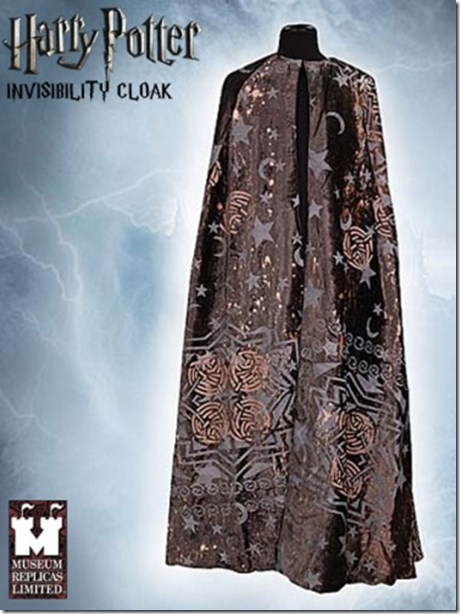
All through the Harry Potter series, an invisibility cloak plays an important part in the story. It is given to Harry as an anonymous Christmas gift in his first year at Hogwarts. It turns out that it was Dumbledore who gave it to him; but that it had belonged to Harry’s father, James. Not until the last book do we learn how and why the cloak came to be in Dumbledore’s possession in the first place. The cloak also turns out to be more unique than Harry and his friends have hitherto realized, in spite of the fact that it has been of immense help to them through seven years.

In an essay I wrote between the sixth and the seventh book, i.e. before any of us readers knew the full story about the invisibility cloak, I made these notes:

The cloak is a mantle, which also belongs to the royal insignia [along with the sceptre=the wand, the crown=the Sorting Hat and the Goblet of Fire – three other objects that also “chose” Harry, rather than he them]. Among the Thirteen Treasures of Britain, we find, as the thirteenth object, “The mantle of [king] Arthur; whosoever was beneath it could see everything, while no one could see him.”

The Invisibility Cloak, I think, should be considered as a kind of opposite of Voldemort’s new body after his rebirth in the cauldron in The Goblet of Fire. This new body is in itself not much more than a Horcrux, since it is not really his own, but is made up of “Bone of the father, unknowingly given,” “Flesh of the servant, willingly given,” and “Blood of the enemy, forcibly taken”. When he rises again from the cauldron, he says: “Robe me”. Voldemort has chosen to become visible and tangible again. The Emperor puts on new clothes but cannot see that in spite of all his royal attire, his scattered soul is still vulnerable.

While Voldemort chooses to become Visible, Harry often chooses to become Invisible by help of his magic cloak.

The idea of the Invisibility Cloak goes even further back than King Arthur. I believe it is connected to the Biblical idea of the Cloak of Righteousness:

I delight greatly in the LORD; 
my soul rejoices in my God.
For he has clothed me with garments of salvation  and arrayed me in a robe of his righteousness  - Isaiah 61:10

In Christian theology, the robe of righteousness is traditionally interpreted as the righteousness of Christ covering our sins and protecting us (the soul if not the body) from evil.

In the Harry Potter story there are many possible layers of interpretation; I believe the author herself is very conscious of them. Harry is in one sense a saviour, but at the same time he is only human. He is a Wizard, but from part Muggle background. The cloak came to him from his Father; and also from Dumbledore who is a sort of father-figure to him (and to all of the students at Hogwarts). The cloak is given to Harry (not initially earned) and it protects him and enables him to fulfill what he must fulfill. It protects not only him, but also his friends.

ABC Wednesday

image

Saturday, 12 March 2011

The White Stag

image

Can you see the white stag?
If not, I suggest you put your spectrespecs on! Smile

The Celts saw white stags as messengers from the Otherworld. In Arthurian legend, the pursuit of the white stag represents mankind’s spiritual quest.

In ‘The Lion, the Witch and the Wardrobe’ by C.S. Lewis,
at the end of the book, it is a White Stag that guides the children (then Kings and Queens of Narnia) back to their own world.

In the Harry Potter series by J.K. Rowling, when Harry learns how to perform a Patronus charm to guard him from the Dementors, it takes the form of a White Stag.

If you read the books, you also know that Harry’s patronus to him represents his dead father, James Potter, whose animagus shape was a stag. Since James is no longer alive, he can be said to belong to “the otherworld”.

image

SPOILER WARNING: If you haven’t read the last book in the series yet, you might want to stop reading here.

image

In the last book, The Deathly Hallows, a white doe (a female deer) also appears at a crucial point in the story. She, too, turns out to be a patronus, representing Harry’s mother, Lily (also dead and hence belonging to the Otherworld). But produced by someone from whom Harry would not expect it…

Well, if you did read the last book – you know who!

Thursday, 25 November 2010

Worth Reading More Than Once


http://btt2.wordpress.com/2010/11/25/thankful-2/

Deb @ 1:39 am:
It’s Thanksgiving here in the U.S. of A. so …
What authors and books are you most thankful for?


I've been taking part in the Booking Through Thursdays for quite a while now, usually from my The Island of the Voices blog. With every week I'm getting increasingly aware that whatever the questions, there are certain authors and books that come more frequently to mind than others. Nothing really strange in that, I suppose. Just goes to show that those authors and books have made a special impact on me. I decided to put this week's answer in my Spectrespecs blog, because...

... over the past decade, I've been especially thankful for J.K. Rowling and the Harry Potter series. This has a lot to do with the fact that when I got acquainted with these books, I was going through hard times, and the Potter series served not only to distract and amuse me, but also to...hm, "expand my ideas" I guess. The fact that it was an ongoing story which was not finished yet when I started reading it, kept my interest up in a unique way.

After an accident ten years ago I ended up with chronic neck problems. I had to give up work and most of my previous social life, and spend a lot of time just resting. Audio books was one way for me to keep myself entertained. I first listened to Harry Potter as Swedish audio book (read by Swedish actor Krister Henriksson). Later, I also bought and read the books in English. From book 5 onwards I bought each of the remaining books in the series on the first day of release. I've also listened to them in English, read by Jim Dale as well as by Stephen Fry. I include the performances of the actors who recorded the books in my thanks, because their voices have "kept me company" and distracted me during many sleepless hours. (I suppose I should also extend my thanks to the film makers and actors in the films; I have all of those on DVD as well. The last two will be added to the collection as soon as they are made available...)

Furthermore I must also include in my thanks the Leaky Lounge internet discussion forum, where I participated for a couple of years between books 6 and 7. Without that forum, I probably wouldn't have become aware of even half the subtleties and references to classic literature, history and mythology that Rowling has woven into her story. I've come to appreciate her vast knowledge of literature, her love of words and names, and her very thorough job with background details (many of which probably slip once-only readers by).

There is one fantasy writer who has made even deeper impact on me, and earlier: C.S. Lewis. His Chronicles of Narnia in particular, but also his theological books, and biographies about his life. For me he is the Author who managed to bring together Reality, Fantasy, Mythology and Christianity and make sense of it. The Narnia books too are among the ones I always return to "when times are rough".

Among the things that make a story worth while to return to, even when you know how it ends, are richness in language, humour, genuine feelings, imagination and lots of details.

Thursday, 14 October 2010

Rewrite Deathly Hallows? No.


http://btt2.wordpress.com/2010/10/14/rewrite/

Suggested by Joy:
If you could rewrite the ending of any book, which book would it be?
And how would you change it?

Looking at the answers already given by some other readers to this Booking Through Thursday question, I saw that more than one person suggested a rewriting of the end of the Harry Potter story - or at least "the end of the end", i.e. the epilogue to the last book, The Deathly Hallows. However, their opinions varied on HOW the ending should be different... One of the answers suggested that the peek into the future would have been better left out, and left to the reader's imagination. Another was disappointed because we were not told enough...

Here is my comment today to
gautami tripathy
of Everything Destils Into Reading:

The Deathly Hallows was not quite what I had expected it to be - and I had a lot of fun speculating about it beforehand... I know quite a few people were disappointed, myself I enjoyed the fact that she managed to surprise me. One of the bits that actually did not surprise me was the very end that you speak of - looking ahead into the future - because Rowling had already said in so many interviews that she intended something like that.

After writing that I went back to my own archives and dug up some comments I made in internet forum dicussions about The Deathly Hallows about six months after I first read the book.

1/ ...And it was in fact much the same things [as some things I had been saying about The Order of the Phoenix] that I liked about The Deathly Hallows even in the first reading. That feeling of being stuck, not being able to get on with what you know you're supposed to do; people telling you what they think is best for you although you haven't asked for help or advice (and they don't even know the full story and you can't tell them); and frustration at not having been told enough (how to destroy the horcruxes); and at the same time having to deal with confusing information you hadn't wished for and weren't prepared for – like the revelations about the life and lies of Albus Dumbledore, and the meaning and purposes of the strange objects he left them in his will, and the Hallows (= having to find your answers in fairy tales!)… I think that as readers we go through a lot of those emotions with Harry & co without quite realizing it, and that may be part of why some readers end up frustrated with the whole book.

To me the biggest "flaw" of the DH plot is probably that Harry's understanding or intuition rushes ahead of ours much too fast towards the end of this book. But again, that's life sometimes: Long periods of nothing and then suddenly everything seems to happen at once. (It struck me as I watched that documentary the other day [about JK Rowling], that from what we know about JK Rowling's life, that's her experience, too!)

2/ [Someone else wrote:] "That is certainly true that it had to be all tied up and couldn't be open - but HBP and OoTP are far more 'adult' books than DH, in a way. DH feels as though it could have been written straight after the first few books."
[My answer:] Yes, that's more or less what I meant by JKR perhaps being more "locked" by her original ideas in the last book than in the previous two. However, I'm not sure I see the book as reverting to being more childish. I was not all that disappointed in DH - the story took some different turns compared to my expectations, but after having accepted that, there are lots of things I like about this book. One of the themes that stand out to me is the necessity of getting "disillusioned" as part of the growing-up-process, and coming to terms with how to handle the fact that your role models and heroes (as well as yourself) turn out to have flaws. But also being able to put the shattered pieces of disappointment together again and "get on with your life": What you saw in the mirror was perhaps not what you thought it was, or wanted it to be, but it might still turn out to be helpful.

3/ Wow, you guys seem to be really disappointed in both DH and the author... There were things that surprised me and that I would have wished to turn out different, but I think my main irritation is with things said in interviews rather than the book itself. (Although I probably haven't read half of the interviews.) I can understand if it was tricky to handle the pre-DH interviews, and that she even had to give sort of misleading answers sometimes, in order not to reveal too much. I find it harder to find excuses for adding to the story after the last book. For example, I thought she was rather wise not to be too explicit in the epilogue; until she started giving that kind of info in post-DH interviews anyway. In my opinion, what did not go into the book should stay out; that is, be left to the reader's interpretation/ imagination. It's very confusing to have a sort of extra canon out there consisting of various quotes made in all kinds of different contexts. So I really prefer to ignore the interviews and keep to the actual text as we have it in the books.

Saturday, 24 July 2010

Dog Days and Sirius Black

 *

[Spoiler warning for readers who have not yet read
Harry Potter and The Order of the Phoenix]


I mentioned in an earlier post about Surnames, Coats of Arms and Family Crests that on the Black coat of arms shield, there are three stars. Sirius is the name of a star, and in Rowling's Black family tree, there are several other "star" first names as well.

The Romans considered Sirius to be the "Dog Star" because it is the brightest star in the constellation Canis Major (Large Dog). Sirius is also the brightest star in the heavens besides the Sun.

As HP readers know, Sirius Black, who was introduced in the third book, The Prisoner of Azkaban, was an Animagus with the ability to turn himself into a big black dog. In that book, the association most played upon was a big black dog as an omen of death, common in the folklore of the British isles.

One thing that I - being Swedish - was not aware of until I came across it today, is that in English, the period from 24 July - 24 August is known as the Dog Days, from Latin diēs caniculārēs, and connected by the ancient Romans with the Dog Star. The term "Dog Days" was also used earlier by the Greeks. (One reason why this had escaped me is that in Swedish, we have another name for this period of the year, which has nothing to do with dogs.)


The Dog Days originally were the days when the star Sirius rose just before or at the same time as sunrise (which Wikpedia points out is no longer true). The Dog Days were popularly believed to be an evil time "when the seas boiled, wine turned sour, dogs grew mad, and all creatures became languid, causing to man burning fevers, hysterics, and phrensies" according to Brady’s Clavis Calendarium, 1813.


And here is the really interesting thing: The Romans sacrificed a dog at the beginning of the Dog Days to appease the rage of Sirius, believing that the star was the cause of the hot, sultry weather.

Sirius Black is described in the books as having that kind of temper - hot and flaring one minute, depressed and steaming the next.

This kind of weather and mood also dominates the fifth book in the series, Harry Potter and The Order of the Phoenix, which culminates in - what? The death of Sirius Black. A death that greatly upset a lot of fans; and J.K. Rowling found herself in an awkward position in quite a few interviews afterwards: Why did this have to happen? One of her answers used to be: It just had to; and she hoped that readers would get to understand it later, in the light of the whole story.

Today as I read in another context about the Roman tradition of sacrificing a dog in the heat of summer, "to appease the rage of Sirius"... and thinking of how Rowling has made use of so many other old stories and traditions like that to build  her own... it suddenly made sense.


The hottest day of the summer so far was drawing to a close and a drowsy silence lay over the large, square houses of Privet Drive.
~The first sentence in Chapter One (Dudley Demented) of
Harry Potter and The Order of the Phoenix.~

---
* http://www.loneoceans.com/lo_main/art/freehand/index.htm

Friday, 12 February 2010

Valentine's Day and Alchemy

In my post Christmas in the Wizarding World (1) I pointed out how J.K. Rowling in Harry Potter and the Philospher's Stone makes a kind of under-the-surface connection between the "Father Christmas" St Nicholas and the Alchemist Nicolas Flamel.

Another holiday celebrated in Rowling's Wizarding World is Valentine's Day.


'Happy Valentine's Day!' Lockhart shouted. 'And may I thank the forty-six people who have so far sent me cards! Yes, I have taken the liberty of arranging this little surprise for you all - and it doesn't end here!'

Lockhart clapped his hands and through the doors to the Entrance Hall marched a dozen surly-looking dwarfs. Not just any dwarfs, however. Lockhart had them all wearing golden wings and carrying harps.

'My friendly, card-carrying cupids!' beamed Lockhart.


J.K. Rowling, Harry Potter and the Chamber of Secrets, ch 13.

Besides Valentine's being a holiday you can have a lot of fun with, I believe Rowling is making a similar under-the-surface connection to the Alchemy theme with this holiday as she is with Christmas.

St Valentine's day is named after one or more early Christian martyrs named Valentine. But there is also in history a Basil Valentine or Basilius Valentinus, who was a 16th century Benedictine monk and alchemist; author of dozens of important publications on alchemy in Latin and German. One of these is Duodecim Claves philosophicæ (The twelve philosophical keys). This is recognised as one of the most influential of alchemical works. It is an obscure text which mixes descriptions of (al)chemical procedures with Biblical images. My own overall impression of it (without claiming to understand every detail) is that the main interpretation is meant to be spiritual. For example, it speaks of the Stone of the Ancients, but also alludes to the Corner Stone or the Rock, which are both images of Christ used in the New Testament. (The Philosopher's Stone of Alchemy was supposed to produce the Elixir of Life, thus giving eternal life. In Biblical imagery, Christ is the Rock who brings forth "living water", and eternal life.)

J.K. Rowling does not refer directly to the name Basil Valentine. However, in The Chamber of Secrets  Valentine's Day is celebrated at Hogwarts (see the quote above). And in the same book, a basilisk  plays an important part. Coincidence? I don't think so. Not with J.K. Rowling. She loves playing around with words and names and meanings.


Woodblock print of a basilisk from Ulisse Aldrovandi,
Monstrorum historia, 1642

In European bestiaries and legends, a basilisk (from the Greek βασιλίσκος basilískos, "little king"; Latin Regulus) is a legendary reptile reputed to be king of serpents and said to have the power to cause death with a single glance.

Please note the connection between the basilisk and the Latin word Regulus. Regulus turns up in later books in the HP series as the name of someone who plays his part in the story although he is already dead when he is first mentioned.

Rowling continues throughout the whole story to make use of images used in alchemical texts and illustrations. Unless the reader is familiar with alchemical imagery already, however, he or she won't see it, or be able to interpret it. And this in itself is what makes it brilliant: because it resembles what the old alchemists themselves did, when they wrote their texts. They used language and images which would only be understood by those who already had some understanding.

Basil Valentine Links from http://www.alchemywebsite.com/:
Basil Valentine
Notes on the Twelve Keys of Basil Valentine
The Twelve Keys (the complete text)

Friday, 18 December 2009

Merry Christmas and Happy New Year


This Santa figure has found his place in front of my Harry Potter books, because he reminds me of Albus Dumbledore...

Wishing all Harry Potter fans a Happy Holiday!

Saturday, 12 December 2009

Christmas in the Wizarding World (2)

Christmas Quotations and Events

The Philosopher's Stone

The Hall looked spectacular. Festoons of holly and mistletoe hung all around the walls and no fewer than twelve towering Christmas trees stood around the room, some sparkling with tiny icicles, some glittering with hundred of candles.

In the first book, Harry gets a mysterious Christmas present from an unknown giver: An invisibility cloak, that according to an attached note had belonged to his father. Covered by the cloak, he goes in the middle of the night to explore the restricted section of the library for information about Nicholas Flamel - but does not (on that occasion) find what he is looking for. Instead, in another room, he finds the Mirror of Erised, which shows him "his heart's desire".


The Chamber of Secrets

... enchanted snow was falling, warm and dry, from the ceiling. Dumbledore led them in a few of his favourite carols, Hagrid booming more and more loudly with every goblet of eggnog he consumed. Percy, who hadn't noticed that Fred had bewitched his prefect's badge so that it now read 'Pinhead', kept asking them all what they were sniggering at.

Disguised by the help of polyjuice potion, Harry and Ron manage to sneak into the Slytherin common room to spy on Draco Malfoy. They do not find the information they were hoping for, but they do find out that the Malfoy family have some secrets...


The Prisoner of Azkaban

Thick streamers of holly and mistletoe were strung along the corridors, mysterious lights shone from inside every suit of armour and the Great Hall was filled with its usual twelve Christmas trees, glittering with golden stars. A powerful and delicious smell of cooking pervaded the corridors, and by Christmas Eve, it had grown so strong that even Scabbers poked his nose out of the shelter of Ron's pocket to sniff hopefully at the air.

Harry receives another anonymous Christmas gift: A Firebolt broomstick. Harry is delighted, but Hermione gets suspicious, and so does Professor McGonagall, and the broomstick is confiscated. Professor Lupin is mysteriously absent from Christmas dinner; and Professor Trelawney is mysteriously present, against her usual habits, and in spite of being superstitious about there being thirteen guests at the table.


The Goblet of Fire

Snow was falling thickly upon the castle and its grounds now. The pale blue Beauxbatons carriage looked like a large, chilly, frosted pumpkin next to the iced gingerbread house that was Hagrid's cabin, while the Durmstrang ship's portholes were glazed with ice, the rigging white with frost. The house-elves down in the kitchen were outdoing themselves with a series of rich, warming strews and savoury puddings...

In the fourth year, Hogwarts is the host of the Triwizard Tournament, with guests from two foreign wizarding schools; and the big Christmas event is the Yule Ball. Harry and Ron have some problems finding courage to ask a girl to the ball (but end up going with the twins Parvati and Padma); while Hermione shows up with world famous Durmstrang Quidditch player Viktor Krum. Of course there are also secrets involved: Harry and Ron overhear a mysterious conversation between Snape and Professor Karkaroff from Durmstrang; they also overhear a revealing conversation between Hagrid and Mme Maxime from Beauxbatons; and on top of that the other Hogwarts Triwizard champion Cedric gives Harry a mysterious tip regarding the next challenge in the Tournament.


The Order of the Phoenix

The fifth year, just before Christmas, Harry has a sort of vision that saves someone's life, but at the same time gives him very unpleasant insights or suspicions about himself. He and his friends and the whole Weasley family end up spending Christmas with Sirius at Grimmauld Place in London instead of at Hogwarts.


Everybody else spent the following morning putting up Christmas decorations. Harry could not remember Sirius ever being in such a good mood; he was actually singing carols, apparently delighted that he was to have company over Christmas. --- by the time they all went to bed on Christmas Eve the house was barely recognisable. The tarnished chandeliers were no longer hung with cobwebs but with garlands of holly and gold and silver streamers; magical snow glittered in heaps over the threadbare carpets; a green Christmas tree, obtained by Mundungus and decorated with live fairies, blocked Sirius's family tree from view, and even the stuffed elf-heads on the hall wall wore Father Christmas hats and beards. Harry awoke on Christmas morning to find a stack of presents at the foot of his bed and Ron already halfway through opening his own, rather larger, pile.

They also pay a visit to the Wizarding Hospital St Mungos, and find out a couple of secrets while they're there...


The Half-Blood Prince

Snow was swirling against the icy windows once more; Christmas was approaching... everlasting candles glowed from inside the helmets of suits of armour and great bunches of  mistletoe had been hung at intervals along the corridors. Large groups of girls tended to converge underneath the mistletoe bunches every time Harry went past, which caused blockages in the corridors; fortunately, however, Harry 's frequent night-time wanderings had given him an unusually good knowledge of the castle's secret passageways, so that he was able, without too much difficulty, to navigate misteltoe-free routes between classes.

The sixth year, besides romance being in the air, Professor Slughorn gives a Christmas party for select students, Harry included. Of course there are also secrets involved: Among other things, in connection with the party, Harry (once more under cover of his invisibility cloak) gets to overhear an interesting conversation between Professor Snape and Draco Malfoy.

The actual Christmas this year is spent at the home of the Weasley family, who apart from their invited guests also receive an unexpected visit.


The Deathly Hallows

In the last book, Harry and Hermione find themselves a long way away from Hogwarts at Christmas; but as in all the previous books, there are very important secrets to find out about...


Then the little lane along which they were walking curved to the left and the heart of the village, a small square, was revealed to them. Strung all around with coloured lights, there was what looked like a war memorial in the middle, partly obscured by a windblown Christmas tree. There were several shops, a post office, a pub and a little church whose stained-glassed windows were glowing jewel bright across the square.
   The snow had become impacted; it was hard and slippery where people had trodden on it all day. Villagers were criss-crossing in front of them, their figures briefly illuminated by street lamps. They heard a snatch of laughter and pop music as the pub door opened and closed; and they heard a carol start up inside the little church.
   'Harry, I think it's Christmas Eve!' said Hermione.
   'Is it?' He had lost track of the date; they had not seen a newspaper for weeks.
   'I am sure it is,' said Hermione, her eyes upon the church. 'They... they'll be in there, won't they? Your mum and dad? I can see the graveyard behind it.'
   Harry felt a thrill of something that was beyond excitement, more like fear. Now that he was so near, he wondered whether he wanted to see, after all.


Friday, 11 December 2009

Christmas in the Wizarding World (1)

One thing I found through taking part in 2½ years of discussions at the Leaky Lounge Harry Potter forums was that readers' opinions on the presence or lack of religion in the Harry Potter books vary a lot.

One of the main holidays celebrated in Rowling's Wizarding World (as in the Muggle World) is Christmas. Like at any other school, the Hogwarts students have Christmas holidays. Most of them go home to celebrate with their families; for those who remain at the school over the holidays, there are also Christmas celebrations held there. Christmas is included in each and every one of the seven books in the series; and the word Christmas is always used - there is no attempt made to replace it with some kind of alternative winter solstice feast. There are Christmas trees, and Christmas gifts, and Christmas dinner, and carols are sung - a bit spookily, even by empty armours!

Except for the mentioning of carols, though, there is really no suggestion of Christmas being a religious celebration. Some readers take this to mean that it is only used to mark the time of year, and that this means that the Wizarding world is a wholly secular world that does not involve any ideas of religion at all. Others, like me, see it a bit differently: I think one reason Rowling does not introduce a separate mythology in her books is that she uses the idea of the wizarding world as an image of spiritual power, and really borrows a lot from Christian and Biblical context. The Wizarding World is not separate from the Muggle world; Muggles just can't see and don't believe in Magic, just as atheists do not believe in the existence or power of a spiritual world.

There is no mentioning of a Father Christmas either in the celebrations of the Wizarding World; but then all Hogwarts students are over 11 years old, so can be supposed to have outgrown that. However... In the first book, Rowling manages to sneak in a nod at the Father Christmas/Santa Claus/St Nicholas tradition anyway: It is at Christmas time that Harry, Hermione and Ron are trying to find out the secret of who Nicolas Flamel is.

"They had indeed been searching books for Flamel's name ever since Hagrid had let it slip, because how else were they going to find out what Snape was trying to steal?" (Philosopher's Stone, Ch 12)

Of course in history, St Nicholas and Nicolas Flamel were different persons, living in different centuries. However, according to traditions, they had at least two qualities in common: They both performed "miracles", and they both gave a lot to charity.

Saint Nicholas is the common name for Nicholas of Myra (270 - 346), a saint and Bishop of Myra (Demre, in Lycia, part of modern-day Turkey). Because of the many miracles attributed to his intercession, he is also known as Nicholas the Wonderworker. He had a reputation for secret gift-giving, such as putting coins in the shoes of those who left them out for him, and thus became the model for Santa Claus. (From Wikipedia article about St Nicholas)

Nicolas Flamel (1330-1418) was a successful French scrivener and manuscript-seller who developed a posthumous reputation as an alchemist due to his reputed work on the philosopher's stone. The essence of his reputation is that he succeeded at the two magical goals of alchemy: that he made the Philosopher's Stone which turns lead into gold, and that he and his wife Perenelle achieved immortality. Flamel's death was recorded in 1418, but his tomb is empty. Rumors spread that Nicolas Flamel never actually died, since witnesses claimed to have seen him in 1761 at an opera in Paris. It is also said that the Flamels used their enormous wealth to support churches and schools and to care for the sick and poor. (From Wikipedia articles about Nicolas Flamel and Perenelle Flamel.)


Portrait of Nicolas Flamel
from a nineteenth century engraving


Harry finally finds the name Nicolas Flamel on a Famous Wizard card that comes with a certain kind of Chocolate Frogs that can be bought in the Wizarding World:

"Professor Dumbledore is particularly famous for his defeat of the dark wizard Grindelwald in 1945, for the discovery of the twelve uses of dragon's blood and his work on alchemy with his partner Nicolas Flamel."

 According to a Hogwarts library book that Hermione finds, Nicolas Flamel is "the only known maker of the philosopher's stone". Apart from transforming any metal into gold, the philospher's stone also "produces The Elixir of Life, which will make the drinker immortal".

And this is of course why the evil wizard Voldemort wants it, and must be stopped from getting it; because he certainly would not be using its powers for charity...

Also notice the word association - Flamel - flame - fire - fireplaces... In the Christmas tradition of the English-speaking world, Santa comes through the chimney. In the Harry Potter series, Fire is the element which represents Gryffindor, the house to which Harry and friends belong, and which has a reputation of bravery, and fighting for the good side. In the HP books, fireplaces are used for transportation and communication - of the good kind, while water (and toilets!) represent Slytherin, and everything sneaky and slimy. (See post from April 2009: Going to the Bathroom.)


In my opinion, Rowling does an excellent job of setting the discoveries of the secrets of Nicolas Flamel in the context of Christmas in the first book.

Neither Flamel nor the philosopher's stone survive to pass on into the following books in the series; but the alchemy theme does, although mostly in much more subtle references. Well hidden references is Rowling's speciality - in fact, a lot of them are so NOT obvious, that if you are not used to looking for them, you can read the whole series without getting any of them. Or you can spend years amusing yourself by trying to find them...!

LinkWithin

Blog Widget by LinkWithin