Showing posts with label ABC. Show all posts

Wednesday, 9 November 2011

Q for Quills

image

As far as the use of Quills is concerned, I think I could have been accepted as a Hogwarts student. … Back in my childhood or teens (long before Harry Potter first popped up in J.K. Rowling’s mind), I used to practice writing with quills made out of crow-feathers. (Just for fun. I’m not quite so old that I did not have access to pens and pencils.)

In The Order of the Phoenix there is a nasty Quill in use which does not need dipping in ink because it uses your own blood instead. Harry is forced by Professor Umbridge to use it to write the text “I must not tell lies” and the words appear on his hand instead of on the paper.

 image

Another famous quill from the Harry Potter books and films is the Quick Quotes Quill used by reporter Rita Skeeter in The Goblet of Fire. This is a magical quill that automatically twists whatever you say into sensational newspaper stuff. I’m not so sure those aren’t secretly used by Muggle reporters as well!

image

ABC Wednesday

Wednesday, 25 May 2011

S for Severus Snape (ABC Wednesday)

image

Alan Rickman as Severus Snape in the Harry Potter films

image

The name Snape is an old one with roots probably dating back to before the Norman Conquest in 1066 AD. There is also more than one place in England called Snape.

Severus is Latin meaning stern, strict, serious.

Severus Snape is Harry’s most hated teacher at Hogwarts. Already in the first book he and Harry take an instant dislike to each other. With Harry it is an instinct kind of thing; with Severus it is based on old grudges to do with Harry’s parents. He despised Harry’s father, and in later books, we learn more about why.

(spoiler warning)

As discussed in a previous post, I believe Rowling has been very conscious of coats of arms and family crests connected with the surnames of her main characters. The stag is a common symbol in heraldry, and it occurs both in the Evans coat of arms (the maiden name of Harry’s mother) and in the Snape coat of arms.

N.b. no direct references to these particular coats of arms and family crests are given in the books; this is all “under the surface” stuff. Importance (or not!) of heritage and ancestry are part of the story though. For example the Black family tree is presented in the fifth book, and the Peverell coat of arms is introduced as a mystery factor in the sixth one.

Harry’s “patronus” shape is a stag. (A patronus is a kind of personal magic guardian that among other things can protect from Dementor attacks. It is closely connected to happy memories and what/whom you love.) The stag was also his father’s Animagus shape (James could transform himself into a stag). In the last book we learn that Snape’s patronus is a doe, and so was that of Lily Evans.

Even from the fifth book it was possible to deduct that there might have been some kind of friendship between Severus and Lily in the past, before she started going out with James. Not until the end of the last book do we get the full picture though: Severus and Lily having a bond that goes back even before Hogwarts.

With Severus Snape, Rowling managed to create an intriguing and mysterious character who got much debated among the readers who followed the series as it was being written. While Harry was clearly the main hero, and Voldemort clearly the main representative of evil; one strength of this series of books is that it also has a number of characters less easy to classify; Snape being the most tricky of them all. And or course there is only one letter that dissociates Snape from Snake…

Not only is Snape Head of the Slytherin’ House at Hogwarts – “There’s not a single witch or wizard who went bad who wasn’t in Slytherin” (PS5; said by Hagrid). It also turns out in later books that he even used to be a Deatheater, i.e. one of Voldemort’s followers. And yet Dumbledore seems to trust him. But he never reveals his reasons…

As the seventh book opens, with Dumbledore gone from the scene, it may seem there is not much room for doubt any more, where Snape’s true loyalty lay. However, this is a book that has doubt as one of it main themes, and things keep getting twisted and turned a few times more before the story finally comes to an end.


Wednesday, 11 May 2011

Q for Quidditch (ABC Wednesday)

image

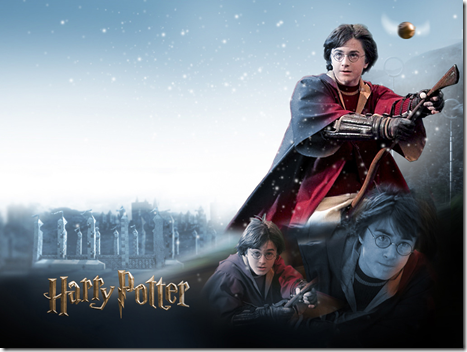
The favourite sports game in J.K. Rowling’s Wizarding world is Quidditch. When Harry is first introduced to it (in the first book, Harry Potter and the Philosopher’s Stone) he tries to sum up his first impression: ‘So – that’s sort of like basketball on broomsticks with six hoops, isn’t it?’

Well, not quite. There are four balls involved – one Quaffle, two Bludgers and the Snitch. And the seven players on each team are divided into one Keeper, three Chasers, two Beaters and one Seeker.

‘Three Chasers try and score with the Quaffle; the Keeper guards the goalposts; the Beaters keep the Bludgers away from their team,’ ...

image

Harry’s position, however, is to be that of Seeker.

‘This,’ said Wood, ‘is the Golden Snitch, and it’s the most important ball of the lot. It’s very hard to catch because it’s so fast and difficult to see. It’s the Seeker’s job to catch it. You’ve got to weave in and out of the Chasers, Beaters, Bludger’s and Quaffle, to get it before the other team’s Seeker, because whichever Seeker catches the Snitch wins his team an extra hundred and fifty points, so they nearly always win. That’s why Seekers get fouled so much. A game of Quiddich only ends when the Snitch is caught, so it can go on for ages – I think the record is three months, they had to keep bringing on substitutes so the players could get some sleep. Well that’s it – any questions?’

image

Quidditch plays a big role throughout the books, except for the last book, which mostly takes place away from school. But the last book still involves a lot of the same elements as a Quidditch game – only more serious. Harry’s role as Seeker is also symbolic throughout the series.

In the first book, a book called Quidditch Through the Ages is referred to. Rowling later published a small book by that name in a separate volume, donating the proceeds to a charity organization called Comic Relief.


Tuesday, 3 May 2011

P for Pensieve (ABC Wednesday)

image

Memories play an important part in the Harry Potter story. In last week’s post, I mentioned occlumency – “the magical defence of the mind against external penetration” – and legilimency – “the ability  to extract feelings and memories from another person’s mind”. As I said then: In Rowling’s Wizarding World, this can get a little more ‘physical’ than we are used to in the Muggle world…

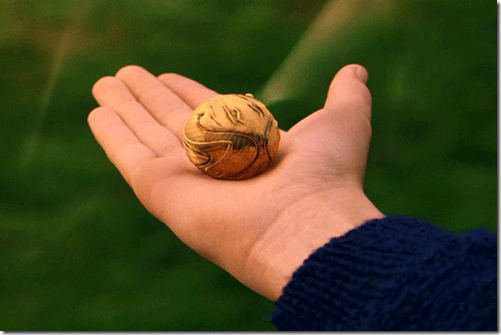
In his Headmaster’s office at Hogwarts, Professor Dumbledore keeps a magical device called the Pensieve. It is introduced to us in Chapter 30 of the fourth book, The Goblet of Fire. Harry discovers it while he is waiting for Dumbledore in his office:

A shallow stone basin lay there, with odd carvings around the edge; runes and symbols that Harry did not recognize. The silvery light was coming from the basin’s contents, which were like nothing Harry had ever seen before. He could not tell whether the substance was liquid or gas. It was a bright, whitish silver, and it was moving ceaselessly; the surface of it became ruffled like water beneath wind, and then, like clouds, separated and swirled smoothly. It looked like light made liquid – or like wind made solid – Harry couldn’t make up his mind.

When Harry bends down over it, he find himself drawn into the substance, and transported to another place and time, where all he can do is watch (he cannot interfere).

When he gets pulled back into the present time, he asks Dumbledore what the thing is.

‘This? It is called a Pensieve,’ said Dumbledore. ‘I sometimes find, and I am sure you know the feeling, that I simply have too many thoughts and memories crammed into my mind.’
’Er,’ said Harry, who couldn’t truthfully say that he had ever felt anything of the sort.
’At these times,’ said Dumbledore, indicating the stone basin, I use the Pensieve. One simply siphons the excess thoughts from one’s mind, pours them into the basin, and examines them at one’s leisure. It becomes easier to spot patterns and links, you understand, when they are in this form.’
’You mean … that stuff’s your thoughts?’ Harry said, staring at the swirling white substance in the basin.
’Certainly,’ said Dumbledore. ‘Let me show you.’

image

Whereupon he demonstrates by drawing out his wand, placing the tip of it near his temple, drawing out a glistening strand of the same kind of substance from his head, adding it to the Pensieve and swirling the stone basin “rather as a gold prospector would swirl for fragments of gold”.

The word Pensieve is of course derived from “pensive” (=deeply thoughtful) and “sieve” (utensil for straining or sifting etc).

The Pensieve continues to be an important object throughout the rest of the series; as is the whole idea of being able to dive into another person’s memories.

The most important difference between using the Pensieve and just listening to someone telling you about their memories, is that with the Pensieve, you get an objective view of what happened; and you are free to draw your own conclusions about it.

But to be able to use the Pensieve, you must first obtain the memory you want to examine, in the form of that physical substance.

Tuesday, 26 April 2011

O for Occlumency (ABC Wednesday)

image

Occlumency: “The magical defence of the mind against external penetration. An obscure branch of magic, but a highly useful one.”

Severus Snape to Harry Potter in The Order of the Phoenix, Ch 24

While Harry is spending the Christmas holidays at the house of his godfather Sirius, his most hated teacher, Snape, turns up and delivers the very unwelcome message that during the next term, the Headmaster, Professor Dumbledore, wants Harry to take private Occlumency lessons from no other than Professor Snape.

‘Dumbledore wants to stop you having those dreams about Voldemort,’ said Hermione at once. ‘Well, you won’t be sorry not to have them any more, will you?’

‘Extra lessons with Snape?’ said Ron, sounding aghast. ‘I’d rather have the nightmares!’

When the lessons start, Snape explains things a bit further. The reason why Dumbledore wants Harry to learn Occlumency is that the Dark Lord (Voldemort) is “highly skilled at Legilimency”, which is “the ability  to extract feelings and memories from another person’s mind”. (A Muggle would call it mind-reading, but in the wizarding world it gets a little more physical.) Occlumency, on the other hand, “seals the mind against magical intrusion and influence”.

Since Harry has a rather emotional personality, he never gets very good at occlumency; but, to quote Dumbledore further on in the story: “in the end, it mattered not”, because he has other qualities that serve him better.

Snape, however, is sort of the embodiment of Occlumency; his character remains a mystery throughout the series, and where his true loyalty lay was one of the favourite subjects of debate while readers were waiting for the last book in the series.

Tuesday, 12 April 2011

M for Marauder’s Map (ABC Wednesday)

image

image

Click here to watch the YouTube video clip from The Prisoner of Azkaban where the Marauder’s Map of Hogwarts Castle is first introduced.

The map is presented to Harry by the Weasley twins Fred and George, who in their first year nicked it from the office of the very impopular school caretaker, Argus Filch. He in turn had confiscated it years before, from the makers of the map, the four Marauders who called themselves Moony, Wormtail, Padfoot and Prongs – all of whom we get to know more about before the end of the third book.

It was a map showing every detail of the Hogwarts castle and grounds. But the truly remarkable thing was the tiny ink dots moving around it, each labelled with a name in minuscule writing. (PoA 10)

The spell to open the map is: “I solemnly swear that I’m up to no good.” And to close it: “Mischief managed.”  Which makes it go back to just a blank piece of parchment for the eyes of those who don’t know its secret.

The map is also put to use in the rest of the series. One of its really tricky qualities is that the little moving dots always show the true name of the person. Something which can be both helpful and deceitful in a world where wizards and witches sometimes use magic to take on someone else’s appearance…

The map is one of the magical objects that come to Harry as a sort of heritage from his father, although he is not aware of it at the time.

… … …

This post is linked to ABC Wednesday.

Tuesday, 5 April 2011

L for Luna (ABC Wednesday)

Luna Lovegood is a character not introduced until the fifth book in the series, although presumably she has been attending Hogwarts since Harry’s second year – being in the same year as Ginny Weasley; but belonging to the House of Ravenclaw rather than to Gryffindor.

Harry (in the company of Neville and Ginny) is first introduced to Luna (sometimes nicknamed ‘Loony’ by her fellow students) on the train to Hogwarts:

The girl gave off an aura of distinct dottiness. Perhaps it was the fact that she had stuck her wand behind her left ear for safekeeping, or that she had chosen to wear a necklace of Butterbeer corks, or that she was reading a magazine upside-down. (OP10)

(It turns out after a while, though, that there was a reason why she was holding the magazine upside-down.) The magazine is The Quibbler, a publication not reputed in the Wizarding World to be the most reliable source of information. However, the editor is Luna’s father; and although he does not know it when they first meet, this will prove useful for Harry later on. Daring to be different – a quality shared by both father and daughter Lovegood – is not necessarily a bad thing. 

The name Luna is Latin for Moon. This fits perfectly with Luna Lovegood’s late appearance in the story. When she comes into it, “darkness” has already begun to take over, after Lord Voldemort again took bodily form at the end of the fourth book. Luna’s first appearance might seem a bit bleak, but before the end, she does get to shine.

Luna in Roman mythology is a moon goddess. (In Greek mythology her name is Selene.) She is often depicted riding either riding on a horse or in a chariot drawn by a pair of winged steeds. Her lunar sphere or crescent is often represented as a crown set upon her head. 

Luna also appears in a sort of trinity with two other moon goddesses: Diana, connected with the woods, wild animals and hunting, and Hecate, connected with the underworld, and with doorways and crossroads. It is said that Luna represents the full moon, Diana the crescent moon, and Hecate the darkness when we don’t see the moon at all.

Interestingly, I also found a note in one of my mythology books that Hecate is sometimes depicted with three different heads: the lion, the horse and the dog.

In The Order of the Phoenix, where we meet Luna, we are also introduced to Thestrals, a kind of invisible, winged, skeleton-resembling, horse-like creatures (used to pull the carriages that transport the students between Hogwarts and the train station). Thestrals can only be seen by those who have seen death. Harry never sees the thestrals until his fifth year – before that the carriages used to seem to him to be moving by magic. Now he can see them, because at the end of his previous school year, he saw a fellow student (Cedric) get killed by Voldemort. Ron and Hermione cannot see the thestrals, so at first don’t understand what Harry is talking about. Luna, however, sees them (her mother died when she was nine), and assures Harry that “You’re just as sane as I am.”

image

The lion is the symbol of the House of Gryffindor (representing fire/light). In OP19, Luna turns up to a Quidditch game showing support for Gryffindor (against Slytherin) wearing a hat shaped like a lion’s head.

image

As for the dog, that’s the animagus shape that Sirius (Harry’s godfather) takes – a big black dog, also associated (in one of the earlier books) with the omen of death, the Grim. In OP, Luna is one of the friends who accompany Harry on a mission to (presumably) rescue Sirius from the “underworld”: Towards the end of the book, she, Harry, Ron, Hermione, Ginny and Neville all fly on thestrals to London, where they enter the Department of Mysteries in the Ministry of Magic headquarters, located underground. One of the most important scenes takes place in a sort of underground amphitheatre; which further connects to old Greek/Roman mythology and drama. There is also an arch (doorway) with a mysterious veil; and Harry and Luna are the only ones who can hear voices “from the other side” (although at the same time you can walk around the arch and see both sides of it).

One person in this scene falls through the veil – and is thereby taken “off stage”, so to say. See a previous post of mine: Dog Days and Sirius Black.

Luna Lovegood’s interest in mystical magical creatures might be another clue to associate her with Diana, the moon godess also associated with woods and wildlife. It is however sort of left open by the author whether some of the creatures whose existence Luna takes for granted are supposed to really exist. - My favourite, of course, is the Crumple-Horned Snorkack, which Luna and her father think they may find in Sweden. We learn a little bit more (or not) about this creature in the last book.

In the last book Luna also becomes (indirectly) associated with a crescent-shaped crown – a diadem, or tiara. (Compare the attributes of Luna the moon goddess.)

… … …

Visit ABC Wednesday
to see what L’s other people have found


Tuesday, 29 March 2011

K for Killing Curse [Avada Kedavra] (ABC Wednesday)

Since last week I wrote about jinxes, I thought I might continue on the same track this week and write something about the Killing Curse used in the Harry Potter books: ‘Avada Kedavra’.

In an audience interview at the Edinburgh Book Festival in 2004, Jo Rowling was asked a question about the use of Latin spells in her books. Here is part of her answer:

“Occasionally you will stumble across something in my Latin that is, almost accidentally, grammatically correct, but that is a rarity. In my defence, the Latin is deliberately odd. Perfect Latin is not a very magical medium, is it? Does anyone know where avada kedavra came from? It is an ancient spell in Aramaic, and it is the original of abracadabra, which means “let the thing be destroyed”. Originally, it was used to cure illness and the “thing” was the illness, but I decided to make it the “thing” as in the person standing in front of me. I take a lot of liberties with things like that. I twist them round and make them mine.”

Rowling's “twist” in this case was probably  influenced by Latin cadaver meaning corpse.

Avada Kedavra is the most feared of all spells in the Wizarding World, because it means instant death. The only person known to have survived it is Harry Potter. Lord Voldemort used the feared curse to kill Harry’s parents; but with Harry, who was still just a baby, he failed. Not until the last book in the series do we find out why.

It is often stressed in the HP books that the power of a spell does not lie in the words alone – you have also got to focus, and mean what you say. Bellatrix Lestrange says to Harry in a fighting scene at the end of The Order of the Phoenix, about another of the Unforgivable curses, Crucio (a torturing curse):

‘Never used an Unforgivable Curse before, have you, boy?’ she yelled. She had abandoned her baby voice now. ‘You need to mean them, Potter! You need to really want to cause pain – to enjoy it – righteous anger won’t hurt me for long – I’ll show you how it is done, shall I? ‘ (OP36)

Curses are also accompanied by flashes of light from the wand used, making the power visible. The Avada Kedavra curse comes with a flash of green; green also being the colour associated with the House of Slytherin, and thus with the Dark Arts.

While power does not lie in the words alone, it is also worth thinking about the idea that words can sometimes be more powerful than we imagine. In the HP books, magic spells are used both to hurt and to heal, to destroy and to defend. This should remind us of the power that we all have.

image

(Photo from one of the Potter films – I think)

Read more: Wikipedia (Abracadabra)

ABC Wednesday


Wednesday, 23 March 2011

J for Jinx (ABC Wednesday)

Among the various things students at The Hogwarts School of Witchcraft and Wizardry come across is a variety of magic spells. The line between different kinds of spells used in the Potter books is sometimes a bit blurry, but basically, a good kind of spell is called a “charm”, while the really bad ones are called “curses”. A jinx is milder than a curse – causing some trouble, but no lasting bodily harm. Jinxes are sometimes used for practical jokes, sometimes defensively to prevent something more serious. (If you happen to be reading this post without having read the books, I should perhaps point out that “the Dark Arts” are not taught at Hogwarts; but “Defense Against the Dark Arts” is.)

The etymology (origin) of the word jinx is obscure. In folklore too it is connected to minor misfortunes and bad luck. One theory is that it may come from the Latin name iynx, for a kind of small woodpecker. In English it is called wryneck, from the ability to turn its head almost 180 degrees. When disturbed at the nest, this bird twists and turns its head in a snakelike way, also making a hissing sound. This odd behaviour led to it being connected with witchcraft.

image

Picture of Wryneck/Jynx from Wikipedia.

Tuesday, 15 March 2011

I for Invisibility Cloak (ABC Wednesday)

image

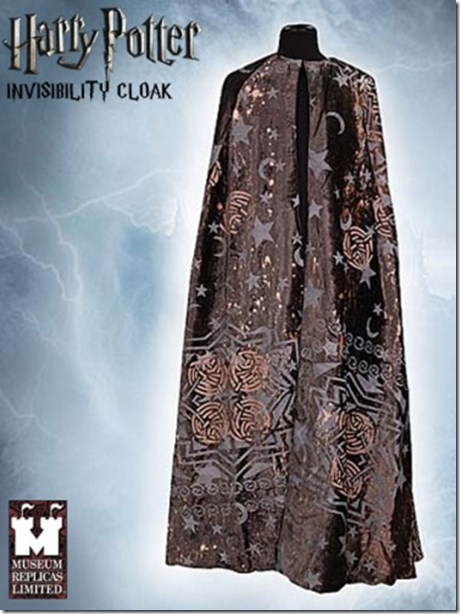
All through the Harry Potter series, an invisibility cloak plays an important part in the story. It is given to Harry as an anonymous Christmas gift in his first year at Hogwarts. It turns out that it was Dumbledore who gave it to him; but that it had belonged to Harry’s father, James. Not until the last book do we learn how and why the cloak came to be in Dumbledore’s possession in the first place. The cloak also turns out to be more unique than Harry and his friends have hitherto realized, in spite of the fact that it has been of immense help to them through seven years.

In an essay I wrote between the sixth and the seventh book, i.e. before any of us readers knew the full story about the invisibility cloak, I made these notes:

The cloak is a mantle, which also belongs to the royal insignia [along with the sceptre=the wand, the crown=the Sorting Hat and the Goblet of Fire – three other objects that also “chose” Harry, rather than he them]. Among the Thirteen Treasures of Britain, we find, as the thirteenth object, “The mantle of [king] Arthur; whosoever was beneath it could see everything, while no one could see him.”

The Invisibility Cloak, I think, should be considered as a kind of opposite of Voldemort’s new body after his rebirth in the cauldron in The Goblet of Fire. This new body is in itself not much more than a Horcrux, since it is not really his own, but is made up of “Bone of the father, unknowingly given,” “Flesh of the servant, willingly given,” and “Blood of the enemy, forcibly taken”. When he rises again from the cauldron, he says: “Robe me”. Voldemort has chosen to become visible and tangible again. The Emperor puts on new clothes but cannot see that in spite of all his royal attire, his scattered soul is still vulnerable.

While Voldemort chooses to become Visible, Harry often chooses to become Invisible by help of his magic cloak.

The idea of the Invisibility Cloak goes even further back than King Arthur. I believe it is connected to the Biblical idea of the Cloak of Righteousness:

I delight greatly in the LORD; 
my soul rejoices in my God.
For he has clothed me with garments of salvation  and arrayed me in a robe of his righteousness  - Isaiah 61:10

In Christian theology, the robe of righteousness is traditionally interpreted as the righteousness of Christ covering our sins and protecting us (the soul if not the body) from evil.

In the Harry Potter story there are many possible layers of interpretation; I believe the author herself is very conscious of them. Harry is in one sense a saviour, but at the same time he is only human. He is a Wizard, but from part Muggle background. The cloak came to him from his Father; and also from Dumbledore who is a sort of father-figure to him (and to all of the students at Hogwarts). The cloak is given to Harry (not initially earned) and it protects him and enables him to fulfill what he must fulfill. It protects not only him, but also his friends.

ABC Wednesday

image

LinkWithin

Blog Widget by LinkWithin