Thursday, 17 March 2011

BTT: Headlines

image[9]

btt buttonDeb @ 1:13 am

http://btt2.wordpress.com/2011/03/17/headlines/

The news has been horrifying and addictive this week, with catastrophe piled on catastrophe, to a degree that–if I had read this in a book or seen it in a movie–I’d be protesting that it was just too unlikely, too farfetched.

But, topics for novels get ripped from the headlines all the time. Or real-life events remind you of fiction (whether “believable” or not) that you’ve read but never expected to see. Or real life comes up with an event so unbelievable that it stretches you sense of reality.

Hmm … I can’t quite come up with an outright question to ask, but thinking about the theory of fiction and how it can affect and be affected by real world events can act as a buffer between the horrific events on the news and having to actually face that horror. So … what happens when the line between fiction and reality becomes all-too slim? Discuss!

… … …

That has got to be the hardest question yet from the weekly Booking Through Thursday meme!

I know I commented to someone yesterday – right now I can’t recall to whom – that one thing that perhaps makes a catastrophe like that in Japan – or, just weeks before, also the earthquake in Christchurch, NZ – come “closer” to us who live on the other side of the world, than some other world events do, is that it was brought about by Nature. We can sympathize without mixing it up (immediately, anyway) with the question of Who To Blame, which is there whenever war or terrorism is involved.

At the same time, having no one to blame often makes us feel helpless and confused. So with any kind of accident we still tend to get hung up on questions like: Could this not have been foreseen and prevented? And to follow: Did we react quickly enough? Were the right decisions made within the first five minutes/first day/whatever? Isn’t there someone whose head should be cut off (at least figuratively) for not doing a better job…?

I suppose that’s one area where fiction steps in as a buffer. In crime fiction for example, things get sorted out in the end. All damage cannot be healed; and people are rarely raised from the dead; but the reader is not left in the darkness of mystery. Someone was to blame and they usually do not go unpunished.

With fantasy literature – at least most that I read - I’d say these kinds of books usually also have a mythological foundation in that there is a battle between good and evil, which often involves also other beings than just humans and animals. (Elves, trolls etc.) Sometimes nature itself gets involved and take sides – like when the trees/ ents march to Isengard in Tolkien’s Lord of the Rings. Landscapes and climate are used to illustrate moods and spiritual status – like mountains and valleys, ice and water, woods and deserts, or flying vs going down deep under the surface. Like the mines of Moria (Tolkien) or the Underland (CS Lewis: The Silver Chair).  Very little is left to pure chance. Somewhere in the background there is spiritual warfare; powers are at work that go far beyond what can be seen.

The relief that fictional stories of this kind brings us (as does religion) is that there is an end to it. There comes a day when we’ll be able to put the book down and say “phew”.

With authors like JRR Tolkien and CS Lewis, their fiction reflects their personal Christian faith, with a deep interest in theology as well as classical mythology (especially Greek, Roman, Celtic and Old Norse, which are all also embedded in our Western culture).

I see the same pattern in JK Rowling’s Harry Potter series. She may be simplifying things in some ways, and complicating them in others. But whether one sees her attempts as wholly successful or not: By letting the Wizarding world and the Muggle world (our modern world at the end of the last century) interact, with only a limited number of characters able to move between both, she does bring in the perspective of “unseen powers” at work.

The sixth book in the Harry Potter series (The Half-Blood Prince) opens with a chapter called “The Other Minister” which describes a meeting between the Prime Minister of England and the Minister for Magic in the Wizarding World (Fudge). The latter has a very different explanation of some recent events that have also mysteriously affected the Muggle world. (Muggles = non-wizards.) Like a collapsed bridge in central London, and a hurricane in the West Country.

The Half Blood Prince was released on 16 July, 2005. Rowling had intended to read from the first chapter of the book at her official presentation. The choice of text for the public reading was changed, because only a week earlier, on 7 July 2005, there had been a series of coordinated suicide attacks upon Londoners using the public transport system during the morning "rush hour". Fifty-six people, including four bombers, were killed by the attacks, and about 700 were injured.

Attacks that came just a little too close to the fictive disasters that open The Half-Blood Prince:

The Prime Minister’s pulse quickened at the very thought of these accusations, for they were neither fair nor true. How on earth was his government supposed to  have stopped that bridge collapsing? It was outrageous for anybody to suggest that they were not spending enough on bridges. The bridge was less than ten years old, and the best experts were at a loss to explain why it had snapped cleanly in two, sending a dozen cars into the watery depths of the river below. And how dared anyone suggest that it was lack of policemen that had resulted in those two very nasty and well-published murders? Or that the government should have somehow foreseen the freak hurricane in the West Country that had caused so much damage to both people and property?

And indeed, the explanation that the Minister for Magic gives turns out to be a little different: Voldemort and his Death Eaters were behind the bridge accident, and as for the hurricane:

‘… and we suspect giant involvement.’
The Prime Minister stopped in his tracks as though he had hit an invisible wall.
’What involvement?’
Fudge grimaced. ‘He used giants last time, when he wanted to go for the grand effect. The Office of Misinformation has been working around the clock, we’ve had teams of Obliviators out trying to modivy the memories of all the Muggles who saw what really happened, we’ve got most of the Department for the Regulation and Control of  Magical Creatures running around Somerset, but we can’t find the giant – it’s been a disaster.’
’You don’t say!’ said the Prime Minister furiously.

So with the tragic London events on everyone’s mind, the text for the public reading on the night of the book release was chosen from another chapter. Just one of those times “when the line between fiction and reality becomes all-too slim”, as Deb puts it in her BTT-question…

---

I’m publishing the above also in my blog Beyond the Lone Islands, since it is from there that I usually take part in the Booking Through Thursday meme.

---

Adding a few extra notes here:

Headlines and distorted news play a very important role throughout the whole Harry Potter series.

Already in the first chapter of the first book (The Philosopher’s Stone) news are “spilling over” from the Wizarding world into the Muggle world:

‘And finally, bird-watchers everywhere have reported that the nation’s owls have been behaving very unusually today. Although owls normally hunt at night and are hardly ever seen in daylight, there have been hundreds of sightings of these birds flying in every direction since sunrise. Experts are unable to explain why the owls have suddenly changed their sleeping pattern.’ ---

‘Well,Ted,’ said the weatherman, ‘… it’s not only the owls that have been acting oddly today. Viewers as far apart as Kent, Yorkshire and Dundee have been phoning in to tell me that instead of the rain I promised yesterday, they’ve had a downpour of shooting stars!…’

(This refers back to when Voldemort/the Dark Lord failed to kill Harry back when he was still a baby. He seemed to disappear after that event. Celebrations broke out in the wizarding world; and owls are the newsbringers of that world.)

In the second book (The Chamber of Secrets) we get to meet Gilderoy Lockhart who loves nothing better than being in the limelight. Until… well. Other even more distorted versions of “truth” are also revealed.

At the beginning of the third book (The Prisoner of Azkaban), the news of an escaped dangerous prisoner (Sirius Black) makes it “across the border” to the Muggle news; of course omitting the fact that the prison he escaped from was located in the realm of magic. Again, things are not exactly as the first might seem.

In the fourth book (The Goblet of Fire), the reporter Rita Skeeter is introduced, working for the Wizarding World’s own newspaper, The Daily Prophet. Her methods of acquiring news turn out to be… unorthodox, to say the least.

In the fifth book (The Order of the Phoenix), we get to know Luna Lovegood, whose father runs the magazine The Quibbler. (Not until the seventh book do we get to meet the man himself.) This book significantly starts with media not reporting the kind of news that Harry is daily expecting them to.

In the seventh  and last book (The Deathly Hallows), a biography of Albus Dumbledore (and newspaper reviews of the same) turns some things upside down for us. Pirate radio broadcasts are also introduced as a way of spreading a different news than those presented by the official media.

Tuesday, 15 March 2011

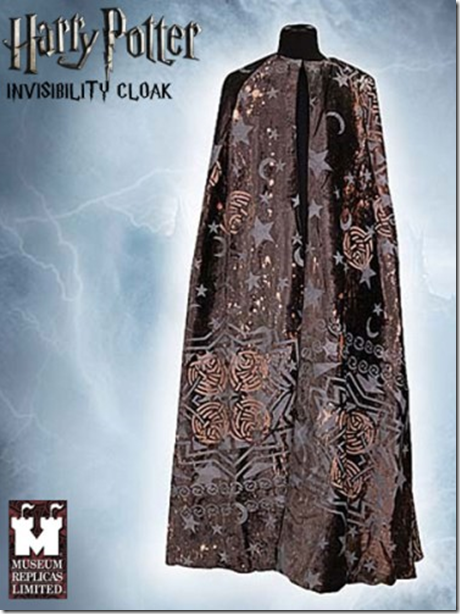
I for Invisibility Cloak (ABC Wednesday)

image

All through the Harry Potter series, an invisibility cloak plays an important part in the story. It is given to Harry as an anonymous Christmas gift in his first year at Hogwarts. It turns out that it was Dumbledore who gave it to him; but that it had belonged to Harry’s father, James. Not until the last book do we learn how and why the cloak came to be in Dumbledore’s possession in the first place. The cloak also turns out to be more unique than Harry and his friends have hitherto realized, in spite of the fact that it has been of immense help to them through seven years.

In an essay I wrote between the sixth and the seventh book, i.e. before any of us readers knew the full story about the invisibility cloak, I made these notes:

The cloak is a mantle, which also belongs to the royal insignia [along with the sceptre=the wand, the crown=the Sorting Hat and the Goblet of Fire – three other objects that also “chose” Harry, rather than he them]. Among the Thirteen Treasures of Britain, we find, as the thirteenth object, “The mantle of [king] Arthur; whosoever was beneath it could see everything, while no one could see him.”

The Invisibility Cloak, I think, should be considered as a kind of opposite of Voldemort’s new body after his rebirth in the cauldron in The Goblet of Fire. This new body is in itself not much more than a Horcrux, since it is not really his own, but is made up of “Bone of the father, unknowingly given,” “Flesh of the servant, willingly given,” and “Blood of the enemy, forcibly taken”. When he rises again from the cauldron, he says: “Robe me”. Voldemort has chosen to become visible and tangible again. The Emperor puts on new clothes but cannot see that in spite of all his royal attire, his scattered soul is still vulnerable.

While Voldemort chooses to become Visible, Harry often chooses to become Invisible by help of his magic cloak.

The idea of the Invisibility Cloak goes even further back than King Arthur. I believe it is connected to the Biblical idea of the Cloak of Righteousness:

I delight greatly in the LORD; 
my soul rejoices in my God.
For he has clothed me with garments of salvation  and arrayed me in a robe of his righteousness  - Isaiah 61:10

In Christian theology, the robe of righteousness is traditionally interpreted as the righteousness of Christ covering our sins and protecting us (the soul if not the body) from evil.

In the Harry Potter story there are many possible layers of interpretation; I believe the author herself is very conscious of them. Harry is in one sense a saviour, but at the same time he is only human. He is a Wizard, but from part Muggle background. The cloak came to him from his Father; and also from Dumbledore who is a sort of father-figure to him (and to all of the students at Hogwarts). The cloak is given to Harry (not initially earned) and it protects him and enables him to fulfill what he must fulfill. It protects not only him, but also his friends.

ABC Wednesday

image

Saturday, 12 March 2011

The White Stag

image

Can you see the white stag?
If not, I suggest you put your spectrespecs on! Smile

The Celts saw white stags as messengers from the Otherworld. In Arthurian legend, the pursuit of the white stag represents mankind’s spiritual quest.

In ‘The Lion, the Witch and the Wardrobe’ by C.S. Lewis,
at the end of the book, it is a White Stag that guides the children (then Kings and Queens of Narnia) back to their own world.

In the Harry Potter series by J.K. Rowling, when Harry learns how to perform a Patronus charm to guard him from the Dementors, it takes the form of a White Stag.

If you read the books, you also know that Harry’s patronus to him represents his dead father, James Potter, whose animagus shape was a stag. Since James is no longer alive, he can be said to belong to “the otherworld”.

image

SPOILER WARNING: If you haven’t read the last book in the series yet, you might want to stop reading here.

image

In the last book, The Deathly Hallows, a white doe (a female deer) also appears at a crucial point in the story. She, too, turns out to be a patronus, representing Harry’s mother, Lily (also dead and hence belonging to the Otherworld). But produced by someone from whom Harry would not expect it…

Well, if you did read the last book – you know who!

Thursday, 25 November 2010

Worth Reading More Than Once


http://btt2.wordpress.com/2010/11/25/thankful-2/

Deb @ 1:39 am:
It’s Thanksgiving here in the U.S. of A. so …
What authors and books are you most thankful for?


I've been taking part in the Booking Through Thursdays for quite a while now, usually from my The Island of the Voices blog. With every week I'm getting increasingly aware that whatever the questions, there are certain authors and books that come more frequently to mind than others. Nothing really strange in that, I suppose. Just goes to show that those authors and books have made a special impact on me. I decided to put this week's answer in my Spectrespecs blog, because...

... over the past decade, I've been especially thankful for J.K. Rowling and the Harry Potter series. This has a lot to do with the fact that when I got acquainted with these books, I was going through hard times, and the Potter series served not only to distract and amuse me, but also to...hm, "expand my ideas" I guess. The fact that it was an ongoing story which was not finished yet when I started reading it, kept my interest up in a unique way.

After an accident ten years ago I ended up with chronic neck problems. I had to give up work and most of my previous social life, and spend a lot of time just resting. Audio books was one way for me to keep myself entertained. I first listened to Harry Potter as Swedish audio book (read by Swedish actor Krister Henriksson). Later, I also bought and read the books in English. From book 5 onwards I bought each of the remaining books in the series on the first day of release. I've also listened to them in English, read by Jim Dale as well as by Stephen Fry. I include the performances of the actors who recorded the books in my thanks, because their voices have "kept me company" and distracted me during many sleepless hours. (I suppose I should also extend my thanks to the film makers and actors in the films; I have all of those on DVD as well. The last two will be added to the collection as soon as they are made available...)

Furthermore I must also include in my thanks the Leaky Lounge internet discussion forum, where I participated for a couple of years between books 6 and 7. Without that forum, I probably wouldn't have become aware of even half the subtleties and references to classic literature, history and mythology that Rowling has woven into her story. I've come to appreciate her vast knowledge of literature, her love of words and names, and her very thorough job with background details (many of which probably slip once-only readers by).

There is one fantasy writer who has made even deeper impact on me, and earlier: C.S. Lewis. His Chronicles of Narnia in particular, but also his theological books, and biographies about his life. For me he is the Author who managed to bring together Reality, Fantasy, Mythology and Christianity and make sense of it. The Narnia books too are among the ones I always return to "when times are rough".

Among the things that make a story worth while to return to, even when you know how it ends, are richness in language, humour, genuine feelings, imagination and lots of details.

Thursday, 14 October 2010

Rewrite Deathly Hallows? No.


http://btt2.wordpress.com/2010/10/14/rewrite/

Suggested by Joy:
If you could rewrite the ending of any book, which book would it be?
And how would you change it?

Looking at the answers already given by some other readers to this Booking Through Thursday question, I saw that more than one person suggested a rewriting of the end of the Harry Potter story - or at least "the end of the end", i.e. the epilogue to the last book, The Deathly Hallows. However, their opinions varied on HOW the ending should be different... One of the answers suggested that the peek into the future would have been better left out, and left to the reader's imagination. Another was disappointed because we were not told enough...

Here is my comment today to
gautami tripathy
of Everything Destils Into Reading:

The Deathly Hallows was not quite what I had expected it to be - and I had a lot of fun speculating about it beforehand... I know quite a few people were disappointed, myself I enjoyed the fact that she managed to surprise me. One of the bits that actually did not surprise me was the very end that you speak of - looking ahead into the future - because Rowling had already said in so many interviews that she intended something like that.

After writing that I went back to my own archives and dug up some comments I made in internet forum dicussions about The Deathly Hallows about six months after I first read the book.

1/ ...And it was in fact much the same things [as some things I had been saying about The Order of the Phoenix] that I liked about The Deathly Hallows even in the first reading. That feeling of being stuck, not being able to get on with what you know you're supposed to do; people telling you what they think is best for you although you haven't asked for help or advice (and they don't even know the full story and you can't tell them); and frustration at not having been told enough (how to destroy the horcruxes); and at the same time having to deal with confusing information you hadn't wished for and weren't prepared for – like the revelations about the life and lies of Albus Dumbledore, and the meaning and purposes of the strange objects he left them in his will, and the Hallows (= having to find your answers in fairy tales!)… I think that as readers we go through a lot of those emotions with Harry & co without quite realizing it, and that may be part of why some readers end up frustrated with the whole book.

To me the biggest "flaw" of the DH plot is probably that Harry's understanding or intuition rushes ahead of ours much too fast towards the end of this book. But again, that's life sometimes: Long periods of nothing and then suddenly everything seems to happen at once. (It struck me as I watched that documentary the other day [about JK Rowling], that from what we know about JK Rowling's life, that's her experience, too!)

2/ [Someone else wrote:] "That is certainly true that it had to be all tied up and couldn't be open - but HBP and OoTP are far more 'adult' books than DH, in a way. DH feels as though it could have been written straight after the first few books."
[My answer:] Yes, that's more or less what I meant by JKR perhaps being more "locked" by her original ideas in the last book than in the previous two. However, I'm not sure I see the book as reverting to being more childish. I was not all that disappointed in DH - the story took some different turns compared to my expectations, but after having accepted that, there are lots of things I like about this book. One of the themes that stand out to me is the necessity of getting "disillusioned" as part of the growing-up-process, and coming to terms with how to handle the fact that your role models and heroes (as well as yourself) turn out to have flaws. But also being able to put the shattered pieces of disappointment together again and "get on with your life": What you saw in the mirror was perhaps not what you thought it was, or wanted it to be, but it might still turn out to be helpful.

3/ Wow, you guys seem to be really disappointed in both DH and the author... There were things that surprised me and that I would have wished to turn out different, but I think my main irritation is with things said in interviews rather than the book itself. (Although I probably haven't read half of the interviews.) I can understand if it was tricky to handle the pre-DH interviews, and that she even had to give sort of misleading answers sometimes, in order not to reveal too much. I find it harder to find excuses for adding to the story after the last book. For example, I thought she was rather wise not to be too explicit in the epilogue; until she started giving that kind of info in post-DH interviews anyway. In my opinion, what did not go into the book should stay out; that is, be left to the reader's interpretation/ imagination. It's very confusing to have a sort of extra canon out there consisting of various quotes made in all kinds of different contexts. So I really prefer to ignore the interviews and keep to the actual text as we have it in the books.

Saturday, 24 July 2010

Dog Days and Sirius Black

 *

[Spoiler warning for readers who have not yet read
Harry Potter and The Order of the Phoenix]


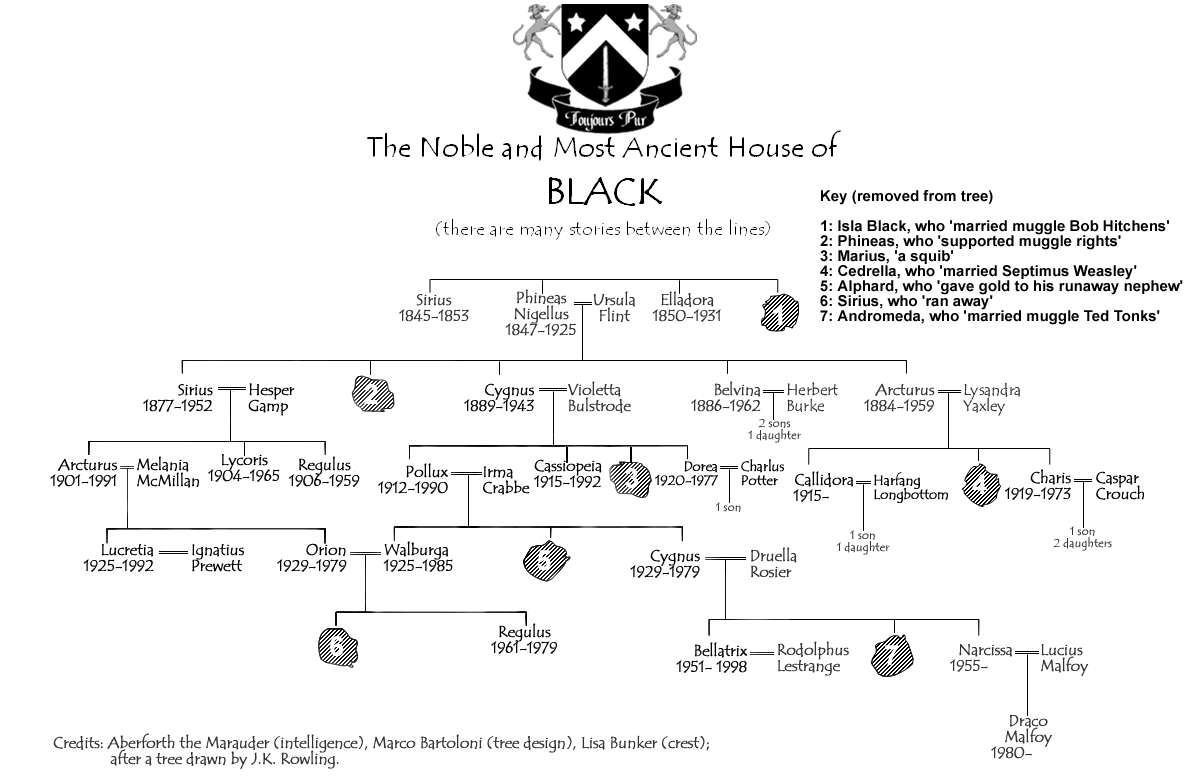
I mentioned in an earlier post about Surnames, Coats of Arms and Family Crests that on the Black coat of arms shield, there are three stars. Sirius is the name of a star, and in Rowling's Black family tree, there are several other "star" first names as well.

The Romans considered Sirius to be the "Dog Star" because it is the brightest star in the constellation Canis Major (Large Dog). Sirius is also the brightest star in the heavens besides the Sun.

As HP readers know, Sirius Black, who was introduced in the third book, The Prisoner of Azkaban, was an Animagus with the ability to turn himself into a big black dog. In that book, the association most played upon was a big black dog as an omen of death, common in the folklore of the British isles.

One thing that I - being Swedish - was not aware of until I came across it today, is that in English, the period from 24 July - 24 August is known as the Dog Days, from Latin diēs caniculārēs, and connected by the ancient Romans with the Dog Star. The term "Dog Days" was also used earlier by the Greeks. (One reason why this had escaped me is that in Swedish, we have another name for this period of the year, which has nothing to do with dogs.)


The Dog Days originally were the days when the star Sirius rose just before or at the same time as sunrise (which Wikpedia points out is no longer true). The Dog Days were popularly believed to be an evil time "when the seas boiled, wine turned sour, dogs grew mad, and all creatures became languid, causing to man burning fevers, hysterics, and phrensies" according to Brady’s Clavis Calendarium, 1813.


And here is the really interesting thing: The Romans sacrificed a dog at the beginning of the Dog Days to appease the rage of Sirius, believing that the star was the cause of the hot, sultry weather.

Sirius Black is described in the books as having that kind of temper - hot and flaring one minute, depressed and steaming the next.

This kind of weather and mood also dominates the fifth book in the series, Harry Potter and The Order of the Phoenix, which culminates in - what? The death of Sirius Black. A death that greatly upset a lot of fans; and J.K. Rowling found herself in an awkward position in quite a few interviews afterwards: Why did this have to happen? One of her answers used to be: It just had to; and she hoped that readers would get to understand it later, in the light of the whole story.

Today as I read in another context about the Roman tradition of sacrificing a dog in the heat of summer, "to appease the rage of Sirius"... and thinking of how Rowling has made use of so many other old stories and traditions like that to build  her own... it suddenly made sense.


The hottest day of the summer so far was drawing to a close and a drowsy silence lay over the large, square houses of Privet Drive.
~The first sentence in Chapter One (Dudley Demented) of
Harry Potter and The Order of the Phoenix.~

---
* http://www.loneoceans.com/lo_main/art/freehand/index.htm

Friday, 12 February 2010

Valentine's Day and Alchemy

In my post Christmas in the Wizarding World (1) I pointed out how J.K. Rowling in Harry Potter and the Philospher's Stone makes a kind of under-the-surface connection between the "Father Christmas" St Nicholas and the Alchemist Nicolas Flamel.

Another holiday celebrated in Rowling's Wizarding World is Valentine's Day.


'Happy Valentine's Day!' Lockhart shouted. 'And may I thank the forty-six people who have so far sent me cards! Yes, I have taken the liberty of arranging this little surprise for you all - and it doesn't end here!'

Lockhart clapped his hands and through the doors to the Entrance Hall marched a dozen surly-looking dwarfs. Not just any dwarfs, however. Lockhart had them all wearing golden wings and carrying harps.

'My friendly, card-carrying cupids!' beamed Lockhart.


J.K. Rowling, Harry Potter and the Chamber of Secrets, ch 13.

Besides Valentine's being a holiday you can have a lot of fun with, I believe Rowling is making a similar under-the-surface connection to the Alchemy theme with this holiday as she is with Christmas.

St Valentine's day is named after one or more early Christian martyrs named Valentine. But there is also in history a Basil Valentine or Basilius Valentinus, who was a 16th century Benedictine monk and alchemist; author of dozens of important publications on alchemy in Latin and German. One of these is Duodecim Claves philosophicæ (The twelve philosophical keys). This is recognised as one of the most influential of alchemical works. It is an obscure text which mixes descriptions of (al)chemical procedures with Biblical images. My own overall impression of it (without claiming to understand every detail) is that the main interpretation is meant to be spiritual. For example, it speaks of the Stone of the Ancients, but also alludes to the Corner Stone or the Rock, which are both images of Christ used in the New Testament. (The Philosopher's Stone of Alchemy was supposed to produce the Elixir of Life, thus giving eternal life. In Biblical imagery, Christ is the Rock who brings forth "living water", and eternal life.)

J.K. Rowling does not refer directly to the name Basil Valentine. However, in The Chamber of Secrets  Valentine's Day is celebrated at Hogwarts (see the quote above). And in the same book, a basilisk  plays an important part. Coincidence? I don't think so. Not with J.K. Rowling. She loves playing around with words and names and meanings.


Woodblock print of a basilisk from Ulisse Aldrovandi,
Monstrorum historia, 1642

In European bestiaries and legends, a basilisk (from the Greek βασιλίσκος basilískos, "little king"; Latin Regulus) is a legendary reptile reputed to be king of serpents and said to have the power to cause death with a single glance.

Please note the connection between the basilisk and the Latin word Regulus. Regulus turns up in later books in the HP series as the name of someone who plays his part in the story although he is already dead when he is first mentioned.

Rowling continues throughout the whole story to make use of images used in alchemical texts and illustrations. Unless the reader is familiar with alchemical imagery already, however, he or she won't see it, or be able to interpret it. And this in itself is what makes it brilliant: because it resembles what the old alchemists themselves did, when they wrote their texts. They used language and images which would only be understood by those who already had some understanding.

Basil Valentine Links from http://www.alchemywebsite.com/:
Basil Valentine
Notes on the Twelve Keys of Basil Valentine
The Twelve Keys (the complete text)

LinkWithin

Blog Widget by LinkWithin