Thursday, 25 November 2010

Worth Reading More Than Once


http://btt2.wordpress.com/2010/11/25/thankful-2/

Deb @ 1:39 am:
It’s Thanksgiving here in the U.S. of A. so …
What authors and books are you most thankful for?


I've been taking part in the Booking Through Thursdays for quite a while now, usually from my The Island of the Voices blog. With every week I'm getting increasingly aware that whatever the questions, there are certain authors and books that come more frequently to mind than others. Nothing really strange in that, I suppose. Just goes to show that those authors and books have made a special impact on me. I decided to put this week's answer in my Spectrespecs blog, because...

... over the past decade, I've been especially thankful for J.K. Rowling and the Harry Potter series. This has a lot to do with the fact that when I got acquainted with these books, I was going through hard times, and the Potter series served not only to distract and amuse me, but also to...hm, "expand my ideas" I guess. The fact that it was an ongoing story which was not finished yet when I started reading it, kept my interest up in a unique way.

After an accident ten years ago I ended up with chronic neck problems. I had to give up work and most of my previous social life, and spend a lot of time just resting. Audio books was one way for me to keep myself entertained. I first listened to Harry Potter as Swedish audio book (read by Swedish actor Krister Henriksson). Later, I also bought and read the books in English. From book 5 onwards I bought each of the remaining books in the series on the first day of release. I've also listened to them in English, read by Jim Dale as well as by Stephen Fry. I include the performances of the actors who recorded the books in my thanks, because their voices have "kept me company" and distracted me during many sleepless hours. (I suppose I should also extend my thanks to the film makers and actors in the films; I have all of those on DVD as well. The last two will be added to the collection as soon as they are made available...)

Furthermore I must also include in my thanks the Leaky Lounge internet discussion forum, where I participated for a couple of years between books 6 and 7. Without that forum, I probably wouldn't have become aware of even half the subtleties and references to classic literature, history and mythology that Rowling has woven into her story. I've come to appreciate her vast knowledge of literature, her love of words and names, and her very thorough job with background details (many of which probably slip once-only readers by).

There is one fantasy writer who has made even deeper impact on me, and earlier: C.S. Lewis. His Chronicles of Narnia in particular, but also his theological books, and biographies about his life. For me he is the Author who managed to bring together Reality, Fantasy, Mythology and Christianity and make sense of it. The Narnia books too are among the ones I always return to "when times are rough".

Among the things that make a story worth while to return to, even when you know how it ends, are richness in language, humour, genuine feelings, imagination and lots of details.

Thursday, 14 October 2010

Rewrite Deathly Hallows? No.


http://btt2.wordpress.com/2010/10/14/rewrite/

Suggested by Joy:
If you could rewrite the ending of any book, which book would it be?
And how would you change it?

Looking at the answers already given by some other readers to this Booking Through Thursday question, I saw that more than one person suggested a rewriting of the end of the Harry Potter story - or at least "the end of the end", i.e. the epilogue to the last book, The Deathly Hallows. However, their opinions varied on HOW the ending should be different... One of the answers suggested that the peek into the future would have been better left out, and left to the reader's imagination. Another was disappointed because we were not told enough...

Here is my comment today to
gautami tripathy
of Everything Destils Into Reading:

The Deathly Hallows was not quite what I had expected it to be - and I had a lot of fun speculating about it beforehand... I know quite a few people were disappointed, myself I enjoyed the fact that she managed to surprise me. One of the bits that actually did not surprise me was the very end that you speak of - looking ahead into the future - because Rowling had already said in so many interviews that she intended something like that.

After writing that I went back to my own archives and dug up some comments I made in internet forum dicussions about The Deathly Hallows about six months after I first read the book.

1/ ...And it was in fact much the same things [as some things I had been saying about The Order of the Phoenix] that I liked about The Deathly Hallows even in the first reading. That feeling of being stuck, not being able to get on with what you know you're supposed to do; people telling you what they think is best for you although you haven't asked for help or advice (and they don't even know the full story and you can't tell them); and frustration at not having been told enough (how to destroy the horcruxes); and at the same time having to deal with confusing information you hadn't wished for and weren't prepared for – like the revelations about the life and lies of Albus Dumbledore, and the meaning and purposes of the strange objects he left them in his will, and the Hallows (= having to find your answers in fairy tales!)… I think that as readers we go through a lot of those emotions with Harry & co without quite realizing it, and that may be part of why some readers end up frustrated with the whole book.

To me the biggest "flaw" of the DH plot is probably that Harry's understanding or intuition rushes ahead of ours much too fast towards the end of this book. But again, that's life sometimes: Long periods of nothing and then suddenly everything seems to happen at once. (It struck me as I watched that documentary the other day [about JK Rowling], that from what we know about JK Rowling's life, that's her experience, too!)

2/ [Someone else wrote:] "That is certainly true that it had to be all tied up and couldn't be open - but HBP and OoTP are far more 'adult' books than DH, in a way. DH feels as though it could have been written straight after the first few books."
[My answer:] Yes, that's more or less what I meant by JKR perhaps being more "locked" by her original ideas in the last book than in the previous two. However, I'm not sure I see the book as reverting to being more childish. I was not all that disappointed in DH - the story took some different turns compared to my expectations, but after having accepted that, there are lots of things I like about this book. One of the themes that stand out to me is the necessity of getting "disillusioned" as part of the growing-up-process, and coming to terms with how to handle the fact that your role models and heroes (as well as yourself) turn out to have flaws. But also being able to put the shattered pieces of disappointment together again and "get on with your life": What you saw in the mirror was perhaps not what you thought it was, or wanted it to be, but it might still turn out to be helpful.

3/ Wow, you guys seem to be really disappointed in both DH and the author... There were things that surprised me and that I would have wished to turn out different, but I think my main irritation is with things said in interviews rather than the book itself. (Although I probably haven't read half of the interviews.) I can understand if it was tricky to handle the pre-DH interviews, and that she even had to give sort of misleading answers sometimes, in order not to reveal too much. I find it harder to find excuses for adding to the story after the last book. For example, I thought she was rather wise not to be too explicit in the epilogue; until she started giving that kind of info in post-DH interviews anyway. In my opinion, what did not go into the book should stay out; that is, be left to the reader's interpretation/ imagination. It's very confusing to have a sort of extra canon out there consisting of various quotes made in all kinds of different contexts. So I really prefer to ignore the interviews and keep to the actual text as we have it in the books.

Saturday, 24 July 2010

Dog Days and Sirius Black

 *

[Spoiler warning for readers who have not yet read
Harry Potter and The Order of the Phoenix]


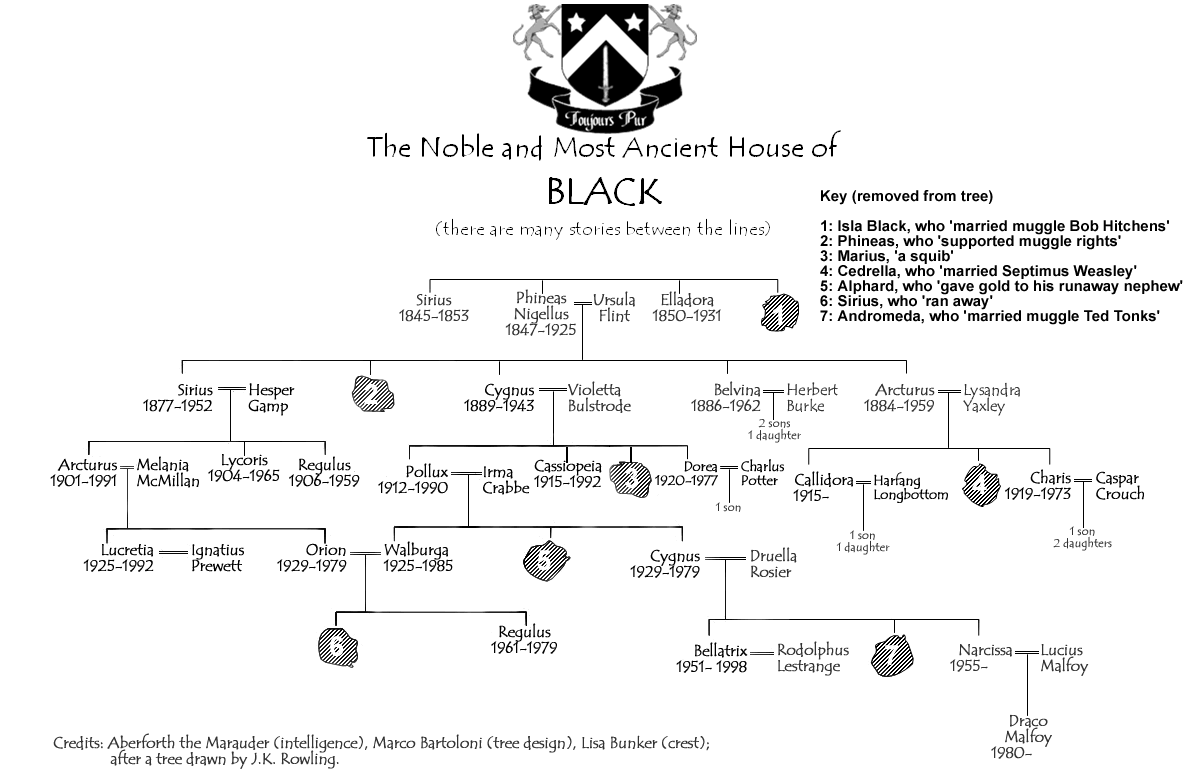
I mentioned in an earlier post about Surnames, Coats of Arms and Family Crests that on the Black coat of arms shield, there are three stars. Sirius is the name of a star, and in Rowling's Black family tree, there are several other "star" first names as well.

The Romans considered Sirius to be the "Dog Star" because it is the brightest star in the constellation Canis Major (Large Dog). Sirius is also the brightest star in the heavens besides the Sun.

As HP readers know, Sirius Black, who was introduced in the third book, The Prisoner of Azkaban, was an Animagus with the ability to turn himself into a big black dog. In that book, the association most played upon was a big black dog as an omen of death, common in the folklore of the British isles.

One thing that I - being Swedish - was not aware of until I came across it today, is that in English, the period from 24 July - 24 August is known as the Dog Days, from Latin diēs caniculārēs, and connected by the ancient Romans with the Dog Star. The term "Dog Days" was also used earlier by the Greeks. (One reason why this had escaped me is that in Swedish, we have another name for this period of the year, which has nothing to do with dogs.)


The Dog Days originally were the days when the star Sirius rose just before or at the same time as sunrise (which Wikpedia points out is no longer true). The Dog Days were popularly believed to be an evil time "when the seas boiled, wine turned sour, dogs grew mad, and all creatures became languid, causing to man burning fevers, hysterics, and phrensies" according to Brady’s Clavis Calendarium, 1813.


And here is the really interesting thing: The Romans sacrificed a dog at the beginning of the Dog Days to appease the rage of Sirius, believing that the star was the cause of the hot, sultry weather.

Sirius Black is described in the books as having that kind of temper - hot and flaring one minute, depressed and steaming the next.

This kind of weather and mood also dominates the fifth book in the series, Harry Potter and The Order of the Phoenix, which culminates in - what? The death of Sirius Black. A death that greatly upset a lot of fans; and J.K. Rowling found herself in an awkward position in quite a few interviews afterwards: Why did this have to happen? One of her answers used to be: It just had to; and she hoped that readers would get to understand it later, in the light of the whole story.

Today as I read in another context about the Roman tradition of sacrificing a dog in the heat of summer, "to appease the rage of Sirius"... and thinking of how Rowling has made use of so many other old stories and traditions like that to build  her own... it suddenly made sense.


The hottest day of the summer so far was drawing to a close and a drowsy silence lay over the large, square houses of Privet Drive.
~The first sentence in Chapter One (Dudley Demented) of
Harry Potter and The Order of the Phoenix.~

---
* http://www.loneoceans.com/lo_main/art/freehand/index.htm

Friday, 12 February 2010

Valentine's Day and Alchemy

In my post Christmas in the Wizarding World (1) I pointed out how J.K. Rowling in Harry Potter and the Philospher's Stone makes a kind of under-the-surface connection between the "Father Christmas" St Nicholas and the Alchemist Nicolas Flamel.

Another holiday celebrated in Rowling's Wizarding World is Valentine's Day.


'Happy Valentine's Day!' Lockhart shouted. 'And may I thank the forty-six people who have so far sent me cards! Yes, I have taken the liberty of arranging this little surprise for you all - and it doesn't end here!'

Lockhart clapped his hands and through the doors to the Entrance Hall marched a dozen surly-looking dwarfs. Not just any dwarfs, however. Lockhart had them all wearing golden wings and carrying harps.

'My friendly, card-carrying cupids!' beamed Lockhart.


J.K. Rowling, Harry Potter and the Chamber of Secrets, ch 13.

Besides Valentine's being a holiday you can have a lot of fun with, I believe Rowling is making a similar under-the-surface connection to the Alchemy theme with this holiday as she is with Christmas.

St Valentine's day is named after one or more early Christian martyrs named Valentine. But there is also in history a Basil Valentine or Basilius Valentinus, who was a 16th century Benedictine monk and alchemist; author of dozens of important publications on alchemy in Latin and German. One of these is Duodecim Claves philosophicæ (The twelve philosophical keys). This is recognised as one of the most influential of alchemical works. It is an obscure text which mixes descriptions of (al)chemical procedures with Biblical images. My own overall impression of it (without claiming to understand every detail) is that the main interpretation is meant to be spiritual. For example, it speaks of the Stone of the Ancients, but also alludes to the Corner Stone or the Rock, which are both images of Christ used in the New Testament. (The Philosopher's Stone of Alchemy was supposed to produce the Elixir of Life, thus giving eternal life. In Biblical imagery, Christ is the Rock who brings forth "living water", and eternal life.)

J.K. Rowling does not refer directly to the name Basil Valentine. However, in The Chamber of Secrets  Valentine's Day is celebrated at Hogwarts (see the quote above). And in the same book, a basilisk  plays an important part. Coincidence? I don't think so. Not with J.K. Rowling. She loves playing around with words and names and meanings.


Woodblock print of a basilisk from Ulisse Aldrovandi,
Monstrorum historia, 1642

In European bestiaries and legends, a basilisk (from the Greek βασιλίσκος basilískos, "little king"; Latin Regulus) is a legendary reptile reputed to be king of serpents and said to have the power to cause death with a single glance.

Please note the connection between the basilisk and the Latin word Regulus. Regulus turns up in later books in the HP series as the name of someone who plays his part in the story although he is already dead when he is first mentioned.

Rowling continues throughout the whole story to make use of images used in alchemical texts and illustrations. Unless the reader is familiar with alchemical imagery already, however, he or she won't see it, or be able to interpret it. And this in itself is what makes it brilliant: because it resembles what the old alchemists themselves did, when they wrote their texts. They used language and images which would only be understood by those who already had some understanding.

Basil Valentine Links from http://www.alchemywebsite.com/:
Basil Valentine
Notes on the Twelve Keys of Basil Valentine
The Twelve Keys (the complete text)

Friday, 18 December 2009

Merry Christmas and Happy New Year


This Santa figure has found his place in front of my Harry Potter books, because he reminds me of Albus Dumbledore...

Wishing all Harry Potter fans a Happy Holiday!

Saturday, 12 December 2009

Christmas in the Wizarding World (2)

Christmas Quotations and Events

The Philosopher's Stone

The Hall looked spectacular. Festoons of holly and mistletoe hung all around the walls and no fewer than twelve towering Christmas trees stood around the room, some sparkling with tiny icicles, some glittering with hundred of candles.

In the first book, Harry gets a mysterious Christmas present from an unknown giver: An invisibility cloak, that according to an attached note had belonged to his father. Covered by the cloak, he goes in the middle of the night to explore the restricted section of the library for information about Nicholas Flamel - but does not (on that occasion) find what he is looking for. Instead, in another room, he finds the Mirror of Erised, which shows him "his heart's desire".


The Chamber of Secrets

... enchanted snow was falling, warm and dry, from the ceiling. Dumbledore led them in a few of his favourite carols, Hagrid booming more and more loudly with every goblet of eggnog he consumed. Percy, who hadn't noticed that Fred had bewitched his prefect's badge so that it now read 'Pinhead', kept asking them all what they were sniggering at.

Disguised by the help of polyjuice potion, Harry and Ron manage to sneak into the Slytherin common room to spy on Draco Malfoy. They do not find the information they were hoping for, but they do find out that the Malfoy family have some secrets...


The Prisoner of Azkaban

Thick streamers of holly and mistletoe were strung along the corridors, mysterious lights shone from inside every suit of armour and the Great Hall was filled with its usual twelve Christmas trees, glittering with golden stars. A powerful and delicious smell of cooking pervaded the corridors, and by Christmas Eve, it had grown so strong that even Scabbers poked his nose out of the shelter of Ron's pocket to sniff hopefully at the air.

Harry receives another anonymous Christmas gift: A Firebolt broomstick. Harry is delighted, but Hermione gets suspicious, and so does Professor McGonagall, and the broomstick is confiscated. Professor Lupin is mysteriously absent from Christmas dinner; and Professor Trelawney is mysteriously present, against her usual habits, and in spite of being superstitious about there being thirteen guests at the table.


The Goblet of Fire

Snow was falling thickly upon the castle and its grounds now. The pale blue Beauxbatons carriage looked like a large, chilly, frosted pumpkin next to the iced gingerbread house that was Hagrid's cabin, while the Durmstrang ship's portholes were glazed with ice, the rigging white with frost. The house-elves down in the kitchen were outdoing themselves with a series of rich, warming strews and savoury puddings...

In the fourth year, Hogwarts is the host of the Triwizard Tournament, with guests from two foreign wizarding schools; and the big Christmas event is the Yule Ball. Harry and Ron have some problems finding courage to ask a girl to the ball (but end up going with the twins Parvati and Padma); while Hermione shows up with world famous Durmstrang Quidditch player Viktor Krum. Of course there are also secrets involved: Harry and Ron overhear a mysterious conversation between Snape and Professor Karkaroff from Durmstrang; they also overhear a revealing conversation between Hagrid and Mme Maxime from Beauxbatons; and on top of that the other Hogwarts Triwizard champion Cedric gives Harry a mysterious tip regarding the next challenge in the Tournament.


The Order of the Phoenix

The fifth year, just before Christmas, Harry has a sort of vision that saves someone's life, but at the same time gives him very unpleasant insights or suspicions about himself. He and his friends and the whole Weasley family end up spending Christmas with Sirius at Grimmauld Place in London instead of at Hogwarts.


Everybody else spent the following morning putting up Christmas decorations. Harry could not remember Sirius ever being in such a good mood; he was actually singing carols, apparently delighted that he was to have company over Christmas. --- by the time they all went to bed on Christmas Eve the house was barely recognisable. The tarnished chandeliers were no longer hung with cobwebs but with garlands of holly and gold and silver streamers; magical snow glittered in heaps over the threadbare carpets; a green Christmas tree, obtained by Mundungus and decorated with live fairies, blocked Sirius's family tree from view, and even the stuffed elf-heads on the hall wall wore Father Christmas hats and beards. Harry awoke on Christmas morning to find a stack of presents at the foot of his bed and Ron already halfway through opening his own, rather larger, pile.

They also pay a visit to the Wizarding Hospital St Mungos, and find out a couple of secrets while they're there...


The Half-Blood Prince

Snow was swirling against the icy windows once more; Christmas was approaching... everlasting candles glowed from inside the helmets of suits of armour and great bunches of  mistletoe had been hung at intervals along the corridors. Large groups of girls tended to converge underneath the mistletoe bunches every time Harry went past, which caused blockages in the corridors; fortunately, however, Harry 's frequent night-time wanderings had given him an unusually good knowledge of the castle's secret passageways, so that he was able, without too much difficulty, to navigate misteltoe-free routes between classes.

The sixth year, besides romance being in the air, Professor Slughorn gives a Christmas party for select students, Harry included. Of course there are also secrets involved: Among other things, in connection with the party, Harry (once more under cover of his invisibility cloak) gets to overhear an interesting conversation between Professor Snape and Draco Malfoy.

The actual Christmas this year is spent at the home of the Weasley family, who apart from their invited guests also receive an unexpected visit.


The Deathly Hallows

In the last book, Harry and Hermione find themselves a long way away from Hogwarts at Christmas; but as in all the previous books, there are very important secrets to find out about...


Then the little lane along which they were walking curved to the left and the heart of the village, a small square, was revealed to them. Strung all around with coloured lights, there was what looked like a war memorial in the middle, partly obscured by a windblown Christmas tree. There were several shops, a post office, a pub and a little church whose stained-glassed windows were glowing jewel bright across the square.
   The snow had become impacted; it was hard and slippery where people had trodden on it all day. Villagers were criss-crossing in front of them, their figures briefly illuminated by street lamps. They heard a snatch of laughter and pop music as the pub door opened and closed; and they heard a carol start up inside the little church.
   'Harry, I think it's Christmas Eve!' said Hermione.
   'Is it?' He had lost track of the date; they had not seen a newspaper for weeks.
   'I am sure it is,' said Hermione, her eyes upon the church. 'They... they'll be in there, won't they? Your mum and dad? I can see the graveyard behind it.'
   Harry felt a thrill of something that was beyond excitement, more like fear. Now that he was so near, he wondered whether he wanted to see, after all.


Friday, 11 December 2009

Christmas in the Wizarding World (1)

One thing I found through taking part in 2½ years of discussions at the Leaky Lounge Harry Potter forums was that readers' opinions on the presence or lack of religion in the Harry Potter books vary a lot.

One of the main holidays celebrated in Rowling's Wizarding World (as in the Muggle World) is Christmas. Like at any other school, the Hogwarts students have Christmas holidays. Most of them go home to celebrate with their families; for those who remain at the school over the holidays, there are also Christmas celebrations held there. Christmas is included in each and every one of the seven books in the series; and the word Christmas is always used - there is no attempt made to replace it with some kind of alternative winter solstice feast. There are Christmas trees, and Christmas gifts, and Christmas dinner, and carols are sung - a bit spookily, even by empty armours!

Except for the mentioning of carols, though, there is really no suggestion of Christmas being a religious celebration. Some readers take this to mean that it is only used to mark the time of year, and that this means that the Wizarding world is a wholly secular world that does not involve any ideas of religion at all. Others, like me, see it a bit differently: I think one reason Rowling does not introduce a separate mythology in her books is that she uses the idea of the wizarding world as an image of spiritual power, and really borrows a lot from Christian and Biblical context. The Wizarding World is not separate from the Muggle world; Muggles just can't see and don't believe in Magic, just as atheists do not believe in the existence or power of a spiritual world.

There is no mentioning of a Father Christmas either in the celebrations of the Wizarding World; but then all Hogwarts students are over 11 years old, so can be supposed to have outgrown that. However... In the first book, Rowling manages to sneak in a nod at the Father Christmas/Santa Claus/St Nicholas tradition anyway: It is at Christmas time that Harry, Hermione and Ron are trying to find out the secret of who Nicolas Flamel is.

"They had indeed been searching books for Flamel's name ever since Hagrid had let it slip, because how else were they going to find out what Snape was trying to steal?" (Philosopher's Stone, Ch 12)

Of course in history, St Nicholas and Nicolas Flamel were different persons, living in different centuries. However, according to traditions, they had at least two qualities in common: They both performed "miracles", and they both gave a lot to charity.

Saint Nicholas is the common name for Nicholas of Myra (270 - 346), a saint and Bishop of Myra (Demre, in Lycia, part of modern-day Turkey). Because of the many miracles attributed to his intercession, he is also known as Nicholas the Wonderworker. He had a reputation for secret gift-giving, such as putting coins in the shoes of those who left them out for him, and thus became the model for Santa Claus. (From Wikipedia article about St Nicholas)

Nicolas Flamel (1330-1418) was a successful French scrivener and manuscript-seller who developed a posthumous reputation as an alchemist due to his reputed work on the philosopher's stone. The essence of his reputation is that he succeeded at the two magical goals of alchemy: that he made the Philosopher's Stone which turns lead into gold, and that he and his wife Perenelle achieved immortality. Flamel's death was recorded in 1418, but his tomb is empty. Rumors spread that Nicolas Flamel never actually died, since witnesses claimed to have seen him in 1761 at an opera in Paris. It is also said that the Flamels used their enormous wealth to support churches and schools and to care for the sick and poor. (From Wikipedia articles about Nicolas Flamel and Perenelle Flamel.)


Portrait of Nicolas Flamel
from a nineteenth century engraving


Harry finally finds the name Nicolas Flamel on a Famous Wizard card that comes with a certain kind of Chocolate Frogs that can be bought in the Wizarding World:

"Professor Dumbledore is particularly famous for his defeat of the dark wizard Grindelwald in 1945, for the discovery of the twelve uses of dragon's blood and his work on alchemy with his partner Nicolas Flamel."

 According to a Hogwarts library book that Hermione finds, Nicolas Flamel is "the only known maker of the philosopher's stone". Apart from transforming any metal into gold, the philospher's stone also "produces The Elixir of Life, which will make the drinker immortal".

And this is of course why the evil wizard Voldemort wants it, and must be stopped from getting it; because he certainly would not be using its powers for charity...

Also notice the word association - Flamel - flame - fire - fireplaces... In the Christmas tradition of the English-speaking world, Santa comes through the chimney. In the Harry Potter series, Fire is the element which represents Gryffindor, the house to which Harry and friends belong, and which has a reputation of bravery, and fighting for the good side. In the HP books, fireplaces are used for transportation and communication - of the good kind, while water (and toilets!) represent Slytherin, and everything sneaky and slimy. (See post from April 2009: Going to the Bathroom.)


In my opinion, Rowling does an excellent job of setting the discoveries of the secrets of Nicolas Flamel in the context of Christmas in the first book.

Neither Flamel nor the philosopher's stone survive to pass on into the following books in the series; but the alchemy theme does, although mostly in much more subtle references. Well hidden references is Rowling's speciality - in fact, a lot of them are so NOT obvious, that if you are not used to looking for them, you can read the whole series without getting any of them. Or you can spend years amusing yourself by trying to find them...!

LinkWithin

Blog Widget by LinkWithin